Top 10 FAQs How Does a Welding Robot Arm Work?

Time:2026-09-20 Author:Henry
0%

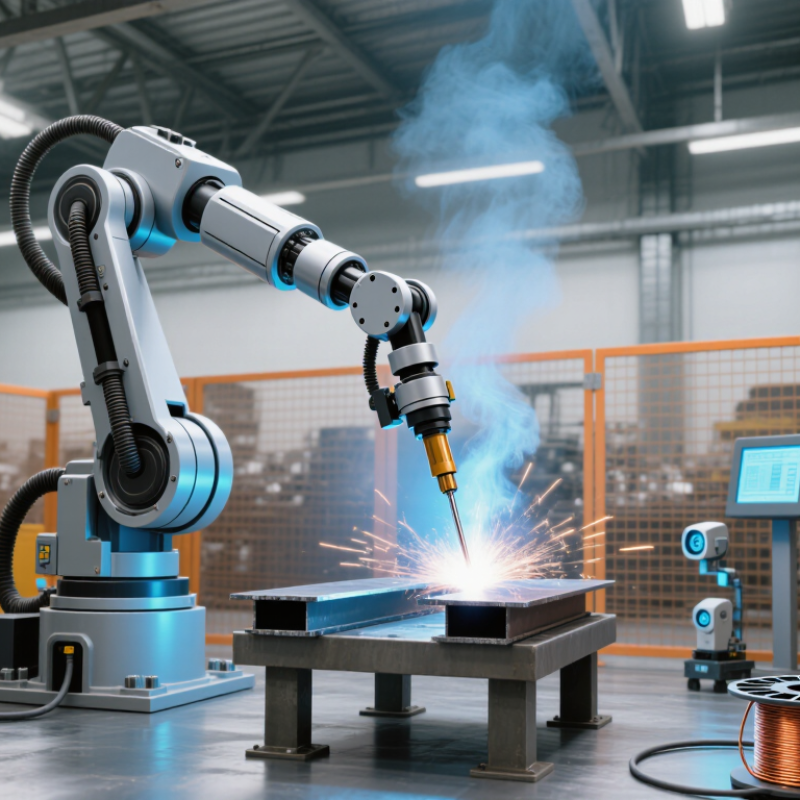
Welding robot arms are no longer limited to large automotive factories. They now support fabrication shops, agricultural equipment makers, and manufacturers producing repeatable metal assemblies. But how does a welding robot arm work in real production? The answer involves more than a robotic arm holding a torch.

The International Federation of Robotics reported 541,302 industrial robots installed worldwide in 2023 in its World Robotics 2024 report. Its data also shows continued demand for automation across manufacturing, despite regional differences and slower growth in some markets. Welding benefits from this movement because robots can repeat programmed paths, maintain torch angles, and control travel speed with consistent timing. A typical cell combines a robot arm, welding power source, wire feeder, torch, positioner, sensors, safety fencing, and control software. Each part matters. A small setup error can create porosity, undercut, or incomplete fusion.

The process usually begins with a digital weld program or guided teaching sequence. An operator defines joint locations, approach points, voltage, current, wire speed, and travel speed. The controller then coordinates the arm and welding equipment while sensors or vision systems help detect variation. It sounds precise. It is not effortless. Material distortion, joint gaps, reflective surfaces, and dirty contact tips can still confuse the system. The American Welding Society emphasizes procedure control, qualified personnel, and inspection as foundations of reliable welding quality. These FAQs examine the complete working cycle, from programming and arc initiation to sensing, maintenance, safety, and quality verification, using practical details rather than exaggerated automation claims.
Top 10 FAQs How Does a Welding Robot Arm Work?

What Is a Welding Robot Arm and What Tasks Does It Perform?

A welding robot arm is a programmable mechanical system that moves a welding torch with controlled speed and accuracy. Most models use several joints, allowing the torch to reach different angles around a metal part. A controller stores movement paths, welding speed, current, voltage, and gas settings. Operators create these paths with teaching software or a handheld control device. The arm can perform tack welds, continuous seams, fillet welds, and repeated joint patterns. It often works with a positioner that rotates the workpiece for better access. Small details matter. A loose fixture can shift the joint by only a few millimeters.

During operation, the robot follows programmed coordinates while feeding wire through the torch. Sensors may detect the seam, arc position, or unexpected contact. A technician checks the fixture, cleans the torch nozzle, and inspects sample welds before production continues. The robot does not think like a human welder. It repeats instructions, not judgment. If the design is poor, it can repeat a poor weld very efficiently. Heat distortion, surface rust, incorrect gaps, and worn contact tips can still cause defects. This is where trained supervision remains essential. In practical workshops, operators often adjust the path after observing spatter, undercut, or uneven penetration. The process is highly consistent, but never completely automatic. Even experienced teams must review weld appearance and test strength when the application demands dependable joints.

What Are the Main Components of a Welding Robot System?

A welding robot system is more than a programmable arm. Its core is a six-axis manipulator, which positions the welding torch with controlled speed and repeatability. A servo motor drives each joint, while an encoder reports its exact position. The controller converts welding programs into coordinated motion, timing, and power commands. In practical cells, this coordination prevents the torch from drifting across a joint.

The torch and wire-feeding unit form the process center. They control electrode delivery, shielding gas, arc voltage, and welding current. A power source supplies the arc, while sensors can monitor seam position, temperature, or arc stability. Fixtures hold the workpiece firmly, and positioners rotate it into a better welding angle. Without rigid fixtures, even an accurate robot can produce inconsistent penetration. That detail is easy to underestimate.

Safety equipment completes the system. Fences, interlocked gates, emergency stops, and light curtains restrict access during operation. ISO 10218 provides widely used safety guidance for industrial robot integration. The International Federation of Robotics reported 541,302 industrial robots were installed worldwide in 2023, showing the scale of automation growth. NIOSH also emphasizes risk assessment, guarding, and worker training around robotic cells. Numbers matter, but installation quality matters more. A system may look advanced and still fail through poor calibration, dirty optics, or weak maintenance planning. The robot is rarely the only problem.

Top 10 FAQs: How Does a Welding Robot Arm Work? – What Are the Main Components of a Welding Robot System?

No. Frequently Asked Question Main System Component How It Works / Key Fact Typical Technical Data
1 How does a welding robot arm work? Robot manipulator and motion controller The controller coordinates the arm’s joints along programmed paths while maintaining the required torch position, angle, travel speed, and welding sequence. Usually 6 axes; repeatability commonly about ±0.05–±0.10 mm
2 What are the main components of a robotic welding system? Robot arm, controller, welding power source, wire feeder, torch, positioner, sensors, and safety equipment These subsystems jointly control movement, arc generation, filler-metal delivery, workpiece orientation, process monitoring, and operator protection. System configuration depends on process, workpiece size, joint design, and production volume
3 What is the function of the robot controller? Robot control cabinet and teach pendant It stores programs, calculates joint movements, manages input and output signals, and synchronizes the robot with the welding equipment and safety circuit. Supports programmed motion, speed control, I/O communication, and emergency-stop functions
4 How is the welding arc generated? Welding power source, torch, work clamp, and grounding circuit The power source establishes and regulates the electrical arc between the electrode and workpiece. The torch delivers current and shielding gas to the weld zone. Common industrial arc processes include GMAW/MIG-MAG, FCAW, and GTAW/TIG
5 How does the system feed welding wire? Wire feeder, drive rolls, liner, contact tip, and wire spool The feeder pushes consumable wire through the liner to the contact tip. Wire-feed speed is synchronized with the welding current and programmed travel speed. Typical wire diameters: approximately 0.8–1.6 mm for automated GMAW applications
6 Why is a positioner used in robotic welding? One- or multi-axis workpiece positioner A positioner rotates or tilts the workpiece so the robot can weld in a favorable position, often improving access, bead consistency, and cycle time. Load capacity and rotation range are selected according to workpiece mass and dimensions
7 What sensors help the robot follow the joint? Through-arc seam tracking, laser vision, touch sensing, and arc sensors Sensors detect joint location, seam deviation, or workpiece variation and can adjust the robot path or welding parameters during production. Useful for compensating for fixture variation, thermal distortion, and part-position errors
8 How is a welding program created? Offline programming software or teach pendant An operator or programmer defines approach points, weld paths, torch orientation, travel speed, arc start and stop commands, and inspection or maintenance routines. Programs commonly include motion points, process parameters, dwell times, and digital I/O commands
9 What safety equipment is required? Safety fence, interlocked gate, light curtain, emergency stop, and welding enclosure The safety system prevents access to the robot’s operating area during hazardous motion and protects personnel from arc radiation, sparks, fumes, and hot surfaces. Safeguarding must be risk-assessed and integrated with the robot’s safety-rated control circuit
10 What affects robotic weld quality and productivity? Fixtures, consumables, process parameters, extraction, and preventive maintenance Consistent part positioning, correct current and voltage, stable shielding gas, clean contact tips, proper torch alignment, and regular maintenance are essential for repeatable welds. Productivity is influenced by arc-on time, cycle time, changeover time, rework rate, and equipment utilization

How Does a Welding Robot Arm Complete a Welding Cycle?

How Does a Welding Robot Arm Complete a Welding Cycle?

A welding robot cycle starts with a digital program and a prepared workpiece. An operator loads the part into a fixed fixture. Sensors confirm its position before motion begins. The controller then sends coordinates, speeds, and welding parameters to the robot. The arm moves toward the joint through a planned approach path. Repeatable positioning matters.

At the programmed start point, the torch aligns with the seam. Shielding gas flows before the arc ignites. The power source creates the welding arc, while the arm maintains travel speed, angle, and distance. Some systems adjust movement when sensors detect joint variation. The International Federation of Robotics reported 541,302 industrial robot installations worldwide in 2023. However, its World Robotics 2024 report does not separate welding applications. That limitation deserves attention.

After the arc stops, gas continues briefly to protect the hot weld. The arm retracts and returns to its home position. A fixture may release the completed part. Quality staff inspect bead appearance, dimensions, and possible defects. Experienced technicians also check spatter around the nozzle. A robot can repeat bad instructions perfectly. Small fixture errors can still produce large welding problems. The cycle looks automatic, but human verification remains necessary. In practice, programming often needs refinement after the first production runs.

How Do Sensors and Programs Control Welding Accuracy?

A welding robot arm follows programmed paths while sensors help it respond to real workshop conditions. The program defines travel speed, torch angle, wire feed, current, and stopping points. Sensors monitor joint position, arc behavior, temperature, and distance from the workpiece. Together, these systems keep the torch near the intended weld line.

A vision sensor can locate a joint, even when parts shift slightly during clamping. A touch sensor may search for the edge before the arc starts. During welding, voltage and current feedback can reveal an unstable arc or changing gap. The controller then adjusts movement or welding settings within approved limits. Small corrections matter. A fraction of a millimeter can affect penetration and bead shape.

Accurate results also depend on calibration, clean lenses, firm fixtures, and reliable weld procedures. Technicians usually test sample welds, inspect cross-sections, and compare measurements with documented requirements. Software cannot repair a badly fitted joint. That part is often underestimated. In practice, sensor readings may become noisy because of spatter, smoke, reflections, or vibration. Operators must check alarms and inspect the finished weld rather than trusting automation blindly. I have found that the most dependable setup is not always the fastest one; slower verification can prevent repeated defects and wasted material.

Top 10 FAQs: How Does a Welding Robot Arm Work?

How Do Sensors and Programs Control Welding Accuracy?

Robotic arc-welding systems combine fast feedback with programmed motion. Joint encoders and arc-current or voltage feedback commonly operate around 1,000 Hz, while seam-tracking sensors typically update at lower rates. Laser profile sensors and vision systems provide geometric information for correcting torch position and detecting weld defects. Actual rates vary according to the sensor type, controller configuration, and welding process.

Values shown are representative nominal update rates used in industrial robotic welding control systems and are not tied to any specific manufacturer.

What Safety, Maintenance, and Quality Checks Does It Require?

A welding robot arm needs disciplined safety controls, not just a fenced cell. The International Federation of Robotics reported 541,302 industrial robots installed worldwide in 2023. More robots mean more responsibility for risk assessment. Before operation, technicians should test guarding, interlocks, emergency stops, and reduced-speed teaching modes. ISO 10218 and ISO/TS 15066 provide useful safety principles for robot systems. Local regulations still decide the final requirements.

Maintenance starts with simple observations. Inspect the torch, liner, contact tip, grounding clamp, cables, and gas hoses each shift. Remove spatter before it changes the wire angle or shielding flow. Check unusual motor noise and position drift. Record every repair. A missed cable crack can create unstable arcs and poor penetration. Quality checks should compare actual current, voltage, travel speed, gas flow, and wire feed against the approved welding procedure. Operators should examine the first completed joint, then sample welds during production. Visual inspection can reveal undercut, porosity, excessive spatter, or inconsistent bead width. Critical assemblies may require non-destructive testing or destructive sample tests. The U.S. Bureau of Labor Statistics recorded 5,283 fatal work injuries in 2023, although that figure covers all industries, not robots alone. It still shows why shortcuts deserve scrutiny. A checklist helps. It cannot replace experienced judgment.

FAQS

What are the main components of a welding robot system?

The main components include a six-axis arm, servo motors, encoders, and a controller. The torch, wire feeder, power source, sensors, fixtures, and safety equipment complete the system. The arm alone is not enough.

What does the robot controller do?

The controller converts digital programs into coordinated movement, timing, and welding commands. It controls torch speed, position, angle, and operating sequences. Poor programming can repeat poor results.

Why are fixtures important in robotic welding?

Fixtures hold workpieces firmly and keep joints in consistent positions. A loose part may shift during welding, causing uneven penetration or bead shape. This detail is easy to underestimate.

How does a typical welding cycle work?

An operator loads the workpiece into a fixture. Sensors confirm its position before the arm moves. The torch approaches the joint, gas flows, and the arc starts. After welding, the torch retracts and the finished part is inspected.

How do sensors improve welding accuracy?

Sensors can detect joint position, torch distance, temperature, and arc stability. Vision sensors may locate shifted seams. Touch sensors can find an edge before welding begins. Small corrections matter.

Can sensors solve every welding problem?

No. Sensors may produce noisy readings because of smoke, spatter, reflections, or vibration. Dirty lenses can also reduce accuracy. Technicians still need to check alarms and inspect finished welds. Automation is not magic.

What safety equipment does a robotic welding cell need?

Common safeguards include physical fences, interlocked gates, emergency stops, and light curtains. Risk assessments and worker training should support the physical protection. Access must remain controlled during operation.

How is welding quality verified after automation?

Quality staff inspect bead appearance, dimensions, penetration, and visible defects. They may examine sample weld cross-sections and compare measurements with requirements. Technicians should also check spatter around the torch nozzle. A perfect-looking cycle can still hide problems.

What maintenance tasks help maintain welding accuracy?

Technicians should calibrate the robot, clean sensors, inspect fixtures, and check the torch. They should review wire feeding, gas flow, and power settings. Maintenance planning is sometimes neglected. A slower check may prevent repeated defects.

Conclusion

A welding robot arm is an automated mechanical system designed to perform repeatable welding tasks with speed, consistency, and controlled movement. It typically includes a robotic arm, welding torch, power source, wire feeder, controller, workholding equipment, and protective enclosures. To understand how does a welding robot arm work, the operator first loads a programmed path and prepares the workpiece. The robot then positions the torch, starts the arc, feeds welding wire, and follows the planned motion to create a stable joint.

Sensors and software help maintain accuracy by monitoring torch position, joint alignment, speed, and welding conditions. If necessary, the control system can adjust movement or other process settings during the cycle. Safety features, such as guarded work areas, emergency stops, and scheduled inspections, help protect personnel and equipment. Regular cleaning, torch replacement, calibration, and cable checks support reliable operation. Finally, visual inspections and measurements confirm that each weld meets the required quality standards.

Henry

Henry

Henry is a dedicated marketing professional with a profound expertise in the company's offerings. With years of experience in the industry, he possesses an impressive understanding of the market dynamics and consumer behaviors that drive success. Henry is committed to sharing his insights through......