What industries use robotic welding arms? The answer reaches far beyond automotive factories. Today, robotic welding arms support vehicle manufacturing, agricultural equipment, construction machinery, rail production, shipbuilding, energy infrastructure, and general metal fabrication. Each industry uses them differently. A car plant may weld hundreds of identical frames daily. A farm-equipment manufacturer may handle thick steel plates with changing joint designs. A shipyard may use robots for repetitive sections, while skilled welders manage difficult positions.
Tommy G. Short, a former American Welding Society president and longtime welding professional, once observed, “The quality of a weld is only as good as the quality of the preparation.” That principle remains practical. A robotic arm cannot correct contaminated steel, poor fixturing, inaccurate programming, or inconsistent joint gaps. It only repeats the process it receives. Sometimes, very precisely.
This guide examines seven practical tips for identifying where robotic welding makes sense. It considers production volume, material thickness, weld accessibility, safety exposure, labor skills, inspection requirements, and return on investment. These factors matter more than industry labels alone. A small fabrication shop may benefit greatly from one flexible cell. A high-volume plant may need several synchronized systems. The wrong setup can become an expensive metal sculpture.
Experience also brings a useful warning. Automation is not automatically better. Operators still need training, maintenance routines, weld inspection, and realistic cycle-time data. Before investing, manufacturers should study their actual parts, not idealized samples. That reflection is easy to skip. It is often the difference between a productive robotic cell and a costly experiment.
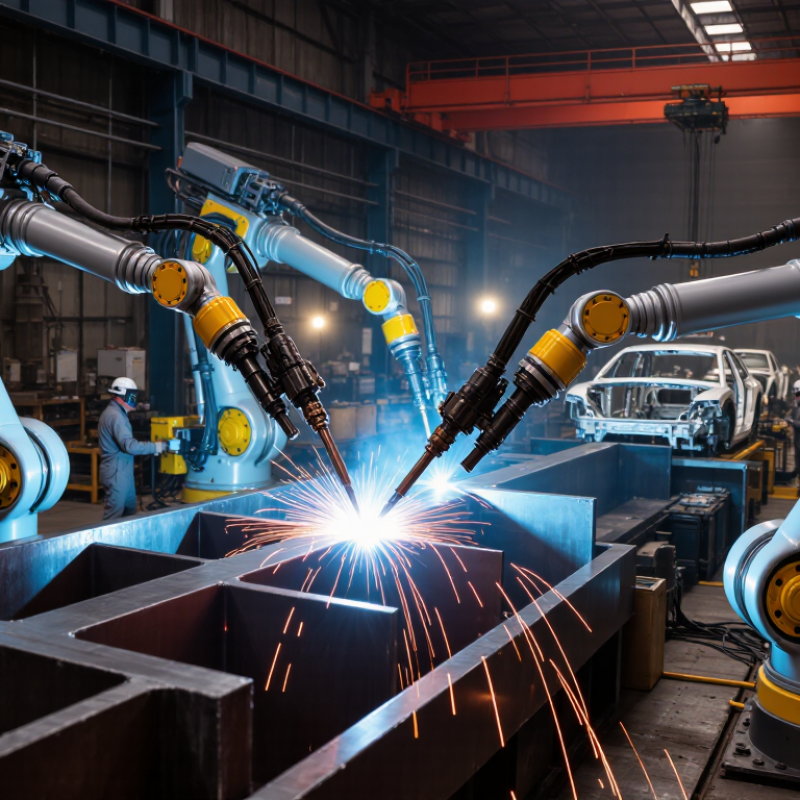
What Industries Use Robotic Welding Arms? Seven Practical Tips
Automotive plants remain major users because production volumes are high and weld paths repeat. The International Federation of Robotics reported 541,302 industrial robots installed worldwide in 2023. Consistent body joints, fixed fixtures, and short cycle times make robotic welding financially attractive. Keep fixtures rigid. Check torch access. Measure cycle time.
Aerospace welding demands tighter process control, not simply faster movement. The International Air Transport Association expects passenger demand to double over the next two decades. That growth increases pressure on aircraft production and repair capacity. Use low-spatter processes. Record heat input. Verify every weld visually and digitally. Aerospace cells also need careful calibration and traceability. Small deviations matter.
Shipbuilding uses robotic arms on long seams, panels, and repetitive structural sections. UNCTAD reported a global merchant fleet exceeding 2.35 billion deadweight tonnes in January 2024. Positioners, seam tracking, and portable cells can reduce awkward manual work. Metal fabrication benefits when steel parts arrive in stable batches. The World Steel Association recorded about 1.89 billion tonnes of crude steel production in 2023. However, high product variety can weaken automation returns. Map joint repeatability. Test changeover time. Price maintenance honestly.
A robot is not automatically faster. A poor fixture can create expensive choreography. I would not automate every seam. Some unusual assemblies still need skilled judgment. (Sources: IFR World Robotics 2024; IATA Global Outlook for Air Transport 2024; UNCTAD Review of Maritime Transport 2024; World Steel Association.)
Automotive Welding: 135,461 Robot Installations in 2023
The automotive sector installed 135,461 industrial robots worldwide in 2023, according to the International Federation of Robotics’ World Robotics 2024 report. This figure shows how rapidly automated welding is entering body shops, chassis lines, and battery-vehicle production. Robotic arms deliver consistent torch angles, stable arc lengths, and repeatable weld penetration. Yet automation is not automatically better. Poor fixture design can repeat the same defect hundreds of times.
Seven practical checks improve welding performance. Select the arm according to payload, reach, and duty cycle. Match the welding process to material thickness and joint geometry. Build rigid fixtures with accessible clamping points. Add sensors for seam tracking and part-position verification. Keep cables away from sharp edges and hot spatter. Record weld current, voltage, speed, and stoppage causes. Train technicians to inspect both software and physical tooling.
Small details matter. A misplaced clamp can shift a seam by millimeters. That error may pass unnoticed during a fast visual check. Operators should verify sample welds through scheduled destructive or non-destructive testing. ISO 10218 safety requirements also support risk assessment, guarding, and controlled access around robotic cells. The IFR data confirms strong adoption, but installation numbers alone cannot prove productivity. Energy use, rework, maintenance time, and worker feedback need measurement. A faster robot can still create a slower factory.
Metal fabrication remains the clearest home for robotic welding arms. The U.S. Bureau of Labor Statistics reported 428,700 welding jobs in 2023. That figure shows a large, active workforce, not an industry disappearing overnight.
Robotic cells often support welders on frames, brackets, tanks, and structural assemblies. Similar systems appear in vehicle, agricultural equipment, and heavy machinery production. Human judgment still matters when joints change or tolerances drift.
Seven practical tips guide a safer purchase:
Start with repeatable parts. Automation struggles with warped sheets and inconsistent gaps. A fixture that feels good enough can create hours of correction. Small tests reveal more than attractive cycle-time claims. Keep a qualified welder involved during programming and acceptance checks.
Quality checks should include bead appearance, penetration records, dimensional measurements, and failed-weld reviews. Maintain guarding, ventilation, and electrical controls through trained personnel.
The exact setup depends on material, thickness, joint design, and local requirements.
One uncomfortable truth deserves attention: faster welding can expose weak upstream planning.
If parts arrive dirty, bent, or late, the robot simply repeats the problem. That is not success. It is measurable feedback for the fabrication team.
Heavy equipment and shipbuilding demand robotic welding arms that tolerate scale, heat, vibration, and long production cycles. Reach matters because frames, hull sections, and boom assemblies contain deep corners and wide weld paths. Measure the complete welding envelope, not only the distance to the nearest joint. A six-axis arm may reach the workpiece, yet still struggle with torch angle or cable routing. That mistake is common.
Payload calculations must include the torch, dress pack, sensors, mounting plate, and any collision protection. Shipyard fixtures can add unexpected leverage. Check the arm’s rated payload at full extension, where performance may feel less confident. Duty cycle deserves equal attention. Heavy equipment lines often run repeated passes for hours, while shipbuilding may involve lengthy welds across thick plate. Select equipment rated for sustained thermal loads, not brief demonstrations.
Environmental protection also changes the decision. Dust, welding fumes, salt air, and grinding debris can shorten service life without proper guarding and maintenance access. Plan torch approach angles around stiffeners, braces, and temporary fixtures. Validate the layout with representative steel sections before installation. Small trials expose awkward repositioning and poor visibility early. A larger arm is not automatically better. In practice, excessive reach can reduce stiffness, increase floor space, and complicate programming. Recheck the design after operators review it; their practical objections often reveal details engineering models miss.
What Industries Use Robotic Welding Arms: Seven Selection Tips
Robotic welding arms serve automotive, heavy equipment, metal furniture, construction, and agricultural machinery production. Selection should begin with the actual weld cell, not the robot catalog. Practical reviews often expose overlooked details, especially cable movement and fixture access.
Check seven points carefully. Confirm payload includes the torch, cables, sensors, and any attached tooling. Match reach and repeatability to the largest workpiece. Review duty cycle, heat exposure, torch cooling, and welding process compatibility. Require safeguarding, emergency stops, operating modes, and controlled access consistent with ISO 10218. Verify the integrator’s risk assessment, not just a compliance statement. Choose programming and maintenance access that reduce awkward postures and downtime. Demand clear manuals, training records, inspection procedures, and spare-part support.
Fume control deserves equal attention. Welding stainless steel or high-alloy materials can generate hexavalent chromium, or Cr(VI). In applicable U.S. workplaces, OSHA sets a 5 µg/m³, 8-hour time-weighted average permissible exposure limit. Use local exhaust ventilation at the arc, verify airflow, and conduct exposure monitoring where required. Do not treat a robot enclosure as automatic protection. Measure near operators, loading stations, and maintenance openings. A small mistake here can matter. The limit may not apply identically everywhere, so confirm current local requirements before commissioning. Some teams also underestimate cleaning and filter-change tasks; those steps need written controls and competent supervision.
Robotic welding arms are widely used in automotive manufacturing, heavy equipment, appliances, metal fabrication, shipbuilding, rail, and structural steel production. The chart compares established occupational exposure limits for hexavalent chromium (Cr(VI)), which may be generated during welding on chromium-containing metals.
Values are airborne Cr(VI) concentrations in micrograms per cubic meter (µg/m³). OSHA’s PEL is an 8-hour time-weighted average; the OSHA action level is one-half of the PEL; the NIOSH REL is a 10-hour time-weighted average.
Automotive plants use them for repeated body joints, chassis parts, and battery-vehicle structures.
Automotive production uses high volumes, fixed fixtures, and repeated weld paths.
Check payload, reach, repeatability, duty cycle, and heat exposure.
Fixtures should remain rigid during clamping and welding.
Yes, but aerospace welding needs careful calibration and process control.
Shipyards use robotic arms for long seams, panels, and repeated structural sections.
Use guarding, emergency stops, controlled access, and clear operating modes.
Use local exhaust ventilation close to the arc.
Measure cycle time, energy use, rework, maintenance, stoppages, and worker feedback.
What industries use robotic welding arms? They are widely used in automotive manufacturing, aerospace production, shipbuilding, heavy equipment, and general metal fabrication. Automotive plants accounted for 135,461 robot installations in 2023, reflecting the value of robotic welding for repeatable, high-volume work. Metal fabrication also offers strong potential, supporting a workforce of 428,700 U.S. welding jobs in 2023 and creating demand for systems that improve productivity, consistency, and operator safety.
When selecting a robotic welding arm, manufacturers should consider seven practical factors: work envelope and reach, payload capacity, duty cycle, welding process compatibility, positioning accuracy, integration requirements, and workplace safety. Heavy equipment and shipbuilding projects often require extended reach, greater payloads, and durable operation under demanding cycles. Proper risk assessment should follow ISO 10218 principles, while ventilation and protective controls should address OSHA’s 5 µg/m³ Cr(VI) permissible exposure limit. A well-matched system can improve weld quality, reduce repetitive labor, and support safer production.

Sandai Robot