Can welding robot arms replace manual welding? The answer is not a clean yes. It depends on joint geometry, production volume, material, tolerances, and the welder’s judgment. A robot can repeat a programmed torch path beside a fixture, but it cannot automatically understand every warped plate, contaminated surface, or last-minute design change. That gap matters on real shop floors.
The International Federation of Robotics reported 541,302 industrial robots were installed worldwide in 2023. This record shows automation is moving from specialist factories into ordinary production lines. Meanwhile, the American Welding Society projects a shortage of more than 330,000 welding professionals in the United States by 2028. Those figures explain the interest in robotic welding. They do not prove that human welders are obsolete.
MIT roboticist Julie Shah has described collaborative robots as “teammates, not replacements.” That idea offers a practical starting point. Welding robot arms can handle long, repetitive beads, maintain steadier travel speeds, and reduce exposure to arc glare, fumes, and awkward postures. Skilled welders can prepare joints, inspect finished beads, correct exceptions, and manage changing workpieces.
There is an uncomfortable limitation. A robot may produce beautiful welds on Tuesday and fail on Wednesday after a fixture shifts two millimeters. Companies also underestimate programming, fixturing, maintenance, and operator training costs. This guide examines where robotic welding genuinely replaces manual work, where it only supports people, and why a blended workflow is often more reliable than full automation.
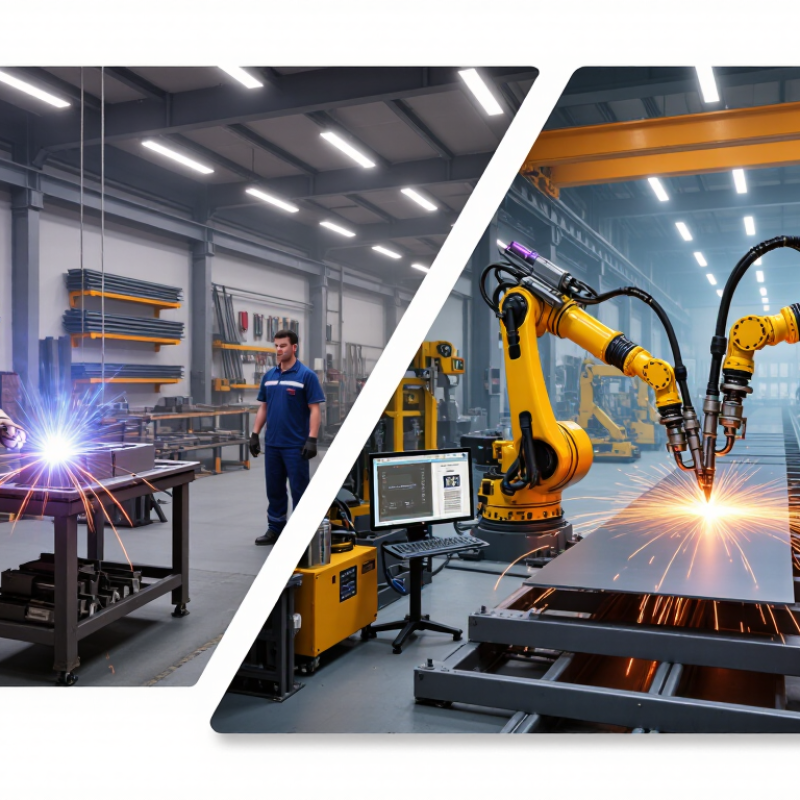
Replacing manual welding with robotic arms begins with a production assessment, not a machine purchase. According to the International Federation of Robotics’ World Robotics 2024 report, 541,302 industrial robots were installed worldwide in 2023. That growth shows strong confidence in automation. It does not prove that every welding line needs a robot. Examine your daily weld count, product variety, joint accessibility, and arc-on time. Robots usually fit repetitive work with stable part geometry. They struggle when operators constantly reposition irregular components.
Labor availability also matters. The American Welding Society has projected a shortage of 330,000 welding professionals by 2028. A robotic cell may protect output when skilled labor is difficult to retain. However, it still needs qualified people for programming, fixture design, inspection, and maintenance. A robot cannot correct poor joint preparation. It may simply repeat the same defect faster. Review defect records, downtime, fixture accuracy, and changeover hours before calculating payback. Include guarding, integration, training, consumables, and scheduled maintenance. The initial estimate is often too optimistic. A practical pilot using one representative product can reveal whether the robot improves quality, utilization, and operator safety. If production depends on frequent design changes, manual welding may remain more flexible. That is not failure. It is a production reality worth measuring.
Selecting the right welding robot arm starts with the weld, not the robot catalog. Map material, joint type, wire size, torch angle, cycle time, and part weight. The International Federation of Robotics reported 541,302 industrial robots installed worldwide in 2023. That figure shows strong adoption, but adoption alone cannot guarantee a sound welding cell.
Choose an arm with sufficient payload, reach, repeatability, and wrist flexibility. Keep a safety margin for the torch, cable package, and sensors. A long reach may look attractive, yet it can reduce stiffness at extended positions. Confirm the robot’s working envelope against real fixtures, not simplified drawings. Small errors become visible as spatter, undercut, or missed starts.
Supporting equipment often determines the result. Specify a stable welding power source, wire feeder, torch-cleaning unit, fume extraction, positioner, guarding, and safety-rated scanners. A positioner should match the robot’s speed and payload. Otherwise, the arm waits, or the weld leaves an awkward angle. ISO 10218 provides key robot safety requirements, while ISO/TS 15066 addresses collaborative robot applications. These standards do not replace a site risk assessment. They guide it.
Use offline programming when product variety is high. Validate paths with actual samples. A perfect specification rarely exists. Production teams may also overlook maintenance access and operator training. That is a costly mistake. The World Robotics 2024 report confirms automation growth, but reliable output still depends on process control, fixturing, and disciplined commissioning.
Replacing manual welding with robot arms starts long before programming. Parts need repeatable geometry, clean edges, and stable fixturing. A 1.5-millimeter gap can change penetration, spatter, and torch access. Fit-up matters. Measure hole locations, joint gaps, and distortion across several shifts, not one perfect sample. The International Federation of Robotics reported 541,302 industrial robot installations worldwide in 2023. That figure shows automation is established, but installation alone cannot guarantee weld quality.
Prepare the workspace around predictable movement. Keep cables away from travel paths, provide consistent part loading, and leave access for inspection and maintenance. Fixtures should locate parts firmly without blocking the torch. Lighting also matters when operators verify tack welds and finished joints. The American Welding Society projects a shortage of 330,000 skilled welding professionals in the United States by 2028. This pressure encourages automation, yet rushing a poor layout creates expensive delays.
The welding process needs its own evidence. Record wire feed speed, voltage, travel speed, shielding gas flow, and heat input for each joint. Then test samples through visual inspection, dimensional checks, and suitable nondestructive testing. ISO 3834 emphasizes controlled welding quality systems, including qualified procedures and traceable records. Early trials may look excellent but fail after fixture wear or material variation. That is normal. Recheck the basics. A robot repeats whatever the team teaches it, including a bad assumption. Keep manual fallback procedures while operators learn recovery, inspection, and safe cell access.
Replacing manual welding with robotic arms begins with disciplined programming, not faster motion. Define the joint sequence, torch angle, travel speed, and wire feed rate from the approved welding procedure. Set the tool center point carefully. A small calibration error can create an uneven bead across a long seam.
Use offline programming for the initial path, then verify it beside the actual fixture. Run the cell without arc power first. Watch clearances around clamps, cables, and part edges. During live testing, inspect bead width, penetration, spatter, and heat distortion at several points. Record each result. A qualified welding engineer should review the parameters and confirm the required safety controls before production.
Optimization comes from measured changes, not guesses. Adjust one variable at a time, such as travel speed or torch work angle. Compare cycle time with weld quality and rework rates. Keep fixture wear in the review, because poor locating can imitate a programming fault. Our first test was not ideal; the robot reached the joint, but its approach created unnecessary wrist rotation. We corrected the path and reduced movement. Still, automated welding needs regular checks. Dust, nozzle buildup, and small fixture shifts can quietly reduce consistency. A simple inspection log often reveals problems before rejected parts increase.
| Implementation Stage | Data Dimension | Manual Welding Baseline | Robotic Welding Cell | Recommended Target | Verification Method | Status |
|---|---|---|---|---|---|---|
| 1. Process Assessment | Weld joint consistency | Operator-dependent bead size, travel speed, and torch angle | Programmed travel speed, torch angle, and weld sequence | Maintain parameter variation within ±5% | Review weld logs and inspect a statistically representative sample of joints | Control Point |
| 1. Process Assessment | Part fit-up tolerance | Typically requires frequent adjustment for dimensional variation | Requires repeatable fixtures and controlled joint gaps | Define fixture and part tolerance before programming | Measure joint gap, part location, and fixture repeatability with calibrated tools | Verify |
| 2. Cell Design | Fixture repeatability | Part positioning may vary between operators | Fixed locating points and clamping sequence | Repeatability suitable for the selected joint tolerance | Run repeated load-and-unload trials and record positional deviation | Verify |
| 2. Cell Design | Operator exposure to arc radiation and fumes | Direct exposure is possible without effective controls | Operator works outside the guarded welding zone during automatic cycles | Use guarding, extraction, interlocks, and approved protective equipment | Complete a workplace risk assessment and confirm safeguards before operation | Control Point |
| 3. Robot Programming | Programming approach | No robot path or parameter program required | Teach weld points, approach paths, retract paths, and sequencing | Use consistent naming, backup files, and documented revisions | Perform a dry run at reduced speed with welding power disabled | Ready After Test |
| 3. Robot Programming | Welding parameters | Adjusted by the welder during production | Stored wire feed speed, voltage, current, gas flow, and travel speed | Lock approved parameter windows for each joint type | Compare controller settings with the qualified welding procedure | Control Point |
| 4. Testing | Dry-run safety test | Usually limited to operator pre-start checks | Checks robot limits, interference, guarding, interlocks, and tooling clearance | Complete all safety checks before arc-on testing | Use a documented checklist and obtain authorization for powered trials | Control Point |
| 4. Testing | First-article weld quality | Quality depends strongly on operator technique | Repeatable programmed motion with controlled parameters | Meet approved visual and dimensional acceptance criteria | Perform visual inspection and applicable non-destructive testing | Verify |
| 5. Production Validation | Arc-on time ratio | Often reduced by repositioning, handling, and fatigue | Can increase through continuous welding and optimized sequencing | Establish a measured baseline; improve without compromising quality | Record arc-on time, cycle time, handling time, and downtime separately | Measure |
| 5. Production Validation | Cycle time per assembly | Varies with operator experience and part handling | Program-defined motion and repeatable work sequence | Reduce non-value-added motion while preserving inspection results | Compare multiple production cycles under equivalent loading conditions | Verify |
| 6. Optimization | Weld spatter and rework | May increase with inconsistent settings or torch manipulation | Improved through stable parameters, TCP accuracy, and cleaning routines | Track defects by type and reduce recurring causes systematically | Use defect records, nozzle inspection, contact-tip checks, and parameter audits | Control Point |
| 6. Optimization | Tool center point accuracy | Torch position is continuously corrected by the operator | TCP must remain calibrated for programmed paths to remain accurate | Check TCP after collisions, tooling changes, or maintenance | Run a documented TCP calibration and compare test weld results | Verify |
| 7. Maintenance | Preventive maintenance compliance | Focuses mainly on welding equipment and hand tools | Includes robot axes, cables, torch, wire feeder, fixtures, and extraction | Complete scheduled tasks before due dates | Review maintenance records, consumable replacement intervals, and alarm history | Control Point |
| 8. Operator Handover | Training and standard work | Training commonly centers on welding technique | Requires training in loading, program selection, alarms, safety, and quality checks | Authorize personnel by task and document competency | Use practical assessments, operating instructions, and shift handover records | Required |
Replacing manual welding with robot arms changes the operator’s role, not its importance. Operators must understand torch angle, travel speed, wire feed, shielding gas, and joint fit-up. A robot repeats instructions; it cannot correct poor preparation.
The International Federation of Robotics reported 541,302 new industrial robots installed worldwide in 2023. This growth increases the need for structured training. Training should begin with safe cell access, teach pendant operation, fixture checks, and controlled recovery from faults. Operators should also inspect weld appearance, spatter, undercut, and penetration. Use real production parts, not only classroom simulations. Small habits matter.
Maintenance protects long-term welding performance. The World Robotics 2024 report recorded more than four million industrial robots operating globally, showing why service discipline matters. A practical schedule should include daily nozzle cleaning, weekly cable and torch inspections, and periodic calibration checks. Record arc time, alarm frequency, tip wear, and rejected welds. These figures expose gradual drift before it becomes expensive. That gap hurts.
In practice, teams sometimes overtrust automatic settings. This is a mistake. Heat buildup, fixture movement, and contaminated surfaces can still weaken welds. Review failed parts with operators and welding engineers together. A simple photo log can connect defects with shifts, materials, and maintenance events. The process will not be perfect. It should remain reviewable, measurable, and open to correction.
Typical operational benchmarks comparing manual welding with a properly trained and maintained robotic welding cell.
Robot welding can improve first-pass acceptance, process repeatability, and equipment availability when operators receive structured training and preventive maintenance is performed on schedule. Actual results vary according to part complexity, joint design, materials, and production volume.
It usually suits repetitive work with stable part geometry. High weld counts and long arc-on time also help. Start small.
Manual welding may offer more flexibility when designs change often. Irregular parts can require constant repositioning. That flexibility matters.
Review weld volume, defect records, downtime, fixture accuracy, and changeover hours. Include guarding, integration, training, consumables, and maintenance. Early estimates are often too optimistic.
No. A robot repeats its instructions. Poor fit-up, dirty surfaces, or incorrect angles may create the same defect repeatedly.
Operators should understand torch angle, travel speed, wire feed, shielding gas, and joint fit-up. They also need fault recovery and fixture-checking skills. The role changes, but remains important.
They should check weld appearance, spatter, undercut, and penetration. Real production parts provide better training than classroom exercises. Small habits matter.
Clean the nozzle daily and inspect cables and the torch weekly. Schedule calibration checks. Record arc time, alarms, tip wear, and rejected welds.
A photo log can connect defects with shifts, materials, and maintenance events. Review failed parts with operators and welding engineers. Automatic settings are not perfect.
Can welding robot arms replace manual welding? In many production environments, the answer is yes, especially when work involves repetitive welds, consistent part geometries, high production volumes, or demanding repeatability. However, successful automation begins with evaluating production needs, weld complexity, material types, required cycle times, and the expected return on investment. Choosing the right robot arm also requires attention to payload, reach, welding equipment, positioners, sensors, safety systems, and workspace layout.
Before installation, parts should be standardized, accurately fixtured, and prepared for reliable access and joint alignment. The welding process must then be programmed, tested, and optimized through controlled trials that address torch angles, travel speed, wire delivery, and quality inspection. Operators need practical training in setup, monitoring, troubleshooting, and safe operation. Regular maintenance, calibration, consumable replacement, and performance reviews will help preserve weld quality and minimize downtime. Automation is most effective when robotic equipment supports skilled personnel rather than replacing process knowledge entirely.

Sandai Robot