Robotic welding automation is moving from a specialist investment to a practical production strategy. In modern fabrication shops, robots repeat weld paths with steady speed and controlled torch movement. They can work beside skilled operators on frames, brackets, pressure-rated components, and large structural assemblies. The result is often more consistent weld quality, fewer repetitive tasks, and clearer production data.
But what is the future of robotic welding automation? It is not simply a factory filled with unattended machines. The stronger direction combines robotics, sensors, simulation software, and experienced welders. Vision systems can detect joint positions, while adaptive controls respond to small changes in fit-up. Weld monitoring can record current, voltage, travel speed, and other process signals. These details help supervisors identify problems before a defective batch leaves the cell.
Practical experience still matters. A robot cannot fix poor fixturing, contaminated surfaces, or inaccurate drawings. Programming may also take longer than expected for short production runs. Small workshops can face high integration costs. These limitations deserve honest attention. Reliable adoption depends on risk assessment, operator training, guarded work areas, and documented quality procedures. Industry standards and qualified welding personnel should guide each installation.
The future will likely favor flexible cells rather than rigid automation. A technician may adjust a digital weld path in the morning, inspect a trial coupon, and release production by afternoon. That vision is promising, but not automatic. Companies must measure cycle time, rework, safety, and return on investment. Robotic welding becomes valuable when technology supports people, not when it replaces careful judgment.
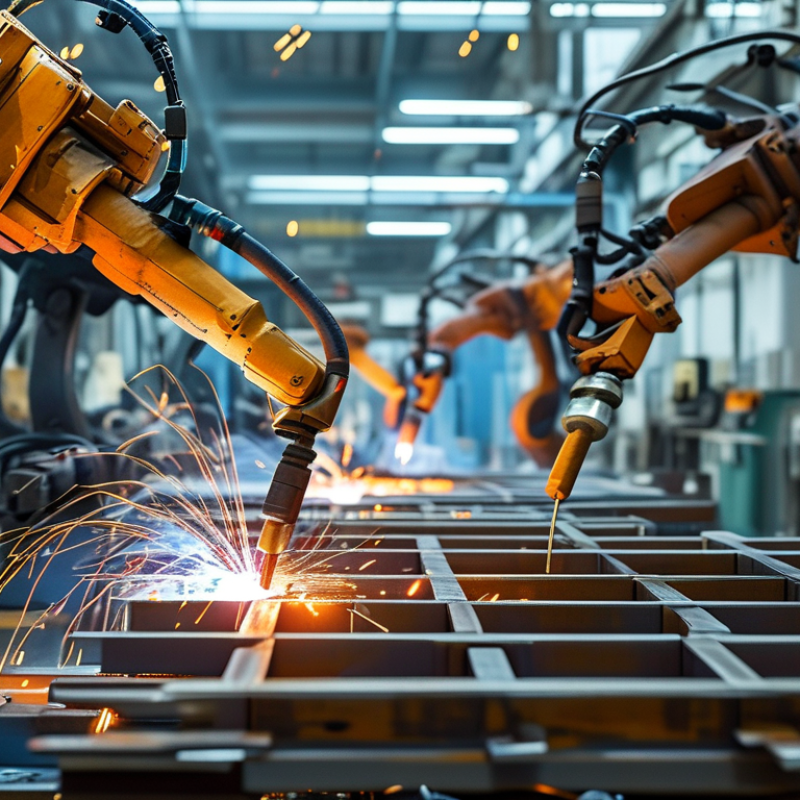
Robotic welding automation is a production system that uses programmable robots to perform welding tasks. The system combines a robotic arm, welding equipment, sensors, fixtures, and control software. Together, these parts guide the torch along a planned joint. The robot repeats the same movement with consistent speed, angle, and distance. The result is repeatable. Human specialists still prepare procedures, select materials, and verify weld quality. Their experience remains essential when joint design or metal thickness changes.
In a typical workshop, an operator loads a steel frame into a fixture. Sensors help confirm its position before welding begins. The robot then follows programmed paths and controls heat input. This can reduce hand strain and support stable output during long production runs. It also creates inspection records, which help engineers trace defects and improve settings. Good automation depends on accurate fixtures, clean surfaces, suitable shielding gas, and regular maintenance. Small alignment errors can still affect penetration and appearance.
It is not magic. A poorly fitted joint can produce a poor weld, even with advanced equipment. Operators need training in programming, welding principles, safety, and inspection. Some irregular or low-volume jobs may remain better suited to skilled manual welders. The future will likely combine robotic consistency with human judgment, rather than remove people completely. That balance deserves careful testing.
Why Is Robotic Welding Automation the Future?
How Robotic Welding Systems Work
A robotic welding system combines a programmable arm, welding power source, controller, fixtures, and sensors. The controller reads a programmed path, then guides the torch along each joint. A positioner can rotate the workpiece, keeping the weld pool stable and accessible. Sensors may detect seam location, joint gaps, or torch distance. This feedback helps correct small variations during production.
The process usually begins with a digital drawing or a taught path. An operator sets travel speed, wire feed, voltage, shielding gas, and torch angle. The robot repeats these movements with consistent timing. According to the International Federation of Robotics’ World Robotics 2024 report, 517,385 industrial robots were installed worldwide in 2023. That figure shows strong automation demand, but it does not guarantee better welds. A poorly fitted joint still creates defects. Automation cannot repair weak process planning.
Tips: Use rigid fixtures and clean surfaces before programming. Validate the first weld with visual inspection and suitable testing. Keep a skilled technician involved, especially when materials or joint designs change. Industry guidance from the American Welding Society emphasizes procedure control, qualified personnel, and inspection records. These steps make robotic welding more reliable. However, every system needs review. Sensor limits, fixture wear, and programming errors can quietly reduce quality. Small details matter.
| System Dimension | How It Works | Typical Data or Range | Operational Value |
|---|---|---|---|
| Robot Motion | A multi-axis articulated arm moves the welding torch along a programmed path and maintains the required angle, distance, and travel speed. | Common industrial systems use 6 axes; positioning repeatability is often approximately ±0.05 to ±0.10 mm. | Produces consistent weld placement and reduces variation between parts. |
| Welding Process | The controller coordinates robot movement with a power source, wire feeder, shielding gas, and torch functions. | Gas metal arc welding is widely automated; typical wire-feed rates are roughly 3–15 m/min, depending on material and joint design. | Maintains repeatable heat input, deposition rate, and weld geometry. |
| Part Detection and Positioning | Fixtures hold components in a known position, while touch sensing, laser sensing, or cameras can locate seams and correct path deviations. | Seam-tracking accuracy commonly depends on joint tolerance, sensor type, surface condition, and travel speed. | Improves performance when part fit-up or component location varies. |
| Arc-On Time | The robot welds automatically while operators load, unload, inspect, and maintain the cell. | Robotic cells can achieve approximately 60–85% arc-on time in well-balanced, high-volume applications; manual welding is often considerably lower. | Increases productive welding time without requiring continuous manual torch handling. |
| Cycle Repeatability | Stored programs repeat the same sequence of movements and welding parameters for every cycle. | Cycle-to-cycle consistency is generally higher than manual welding when fixtures, consumables, and joint conditions are controlled. | Reduces weld variation, rework, and dependence on individual operator technique. |
| Safety Functions | The cell uses guarding, interlocked access doors, emergency stops, and safety-rated control systems to limit access during operation. | The exact safety design depends on the cell layout, risk assessment, robot configuration, and applicable workplace regulations. | Separates workers from arc radiation, spatter, fumes, heat, and repetitive torch movements. |
| Quality Monitoring | Controllers can record current, voltage, wire-feed speed, travel speed, gas flow, alarms, and program status. | Monitoring parameters are selected according to the welding procedure, material, joint type, and quality requirements. | Creates traceable production records and helps identify process deviations. |
| Material Utilization | Stable torch movement and controlled parameters help limit excessive weld size, spatter, and unnecessary wire consumption. | Actual savings vary with joint preparation, welding procedure, consumables, and operator practices. | Can reduce consumable waste, cleanup time, and production cost. |
| Production Flexibility | Different weld paths and parameter sets can be stored and recalled for compatible products. | Changeover time depends on fixture design, programming method, part variation, and the number of welds. | Supports repeatable production across multiple part designs and batch sizes. |
| Human Role | Operators and technicians prepare fixtures, load parts, supervise the process, inspect welds, maintain equipment, and adjust programs. | Automation changes the skill mix; programming, inspection, maintenance, and process knowledge remain essential. | Moves people away from hazardous, strenuous, and highly repetitive tasks toward higher-value work. |
Note: Performance ranges are typical industry values and can vary with material, joint design, welding process, fixture quality, programming, production volume, and safety requirements.
Manufacturers adopt robotic welding automation because it solves daily production problems, not because it sounds futuristic. In a busy fabrication cell, a robot follows the same programmed path across hundreds of joints. It maintains steadier torch angles, travel speeds, and heat input than tired workers often can. That consistency can reduce spatter, rework, and unpredictable delivery dates. Operators remain essential. They prepare fixtures, monitor welds, and handle unusual parts.
Labor availability also influences the decision. Skilled welders are valuable, yet repetitive work can cause fatigue and ergonomic strain. Automation moves continuous torch work away from the most demanding tasks. Manufacturers can then use experienced staff for setup, inspection, troubleshooting, and process improvement. Production records add another advantage. Cycle times, fault events, and inspection results create evidence for quality decisions. When a weld fails, teams can investigate settings instead of relying only on memory. This supports documented procedures and more reliable customer communication.
Adoption is not effortless. A poorly designed fixture can make an expensive robot repeat bad positioning perfectly. Programming, safety training, maintenance, and integration require time and honest budgeting. Some companies also underestimate part variation. A system that handles one stable product may struggle with small batches. Engineers should test representative parts, measure results, and keep human review in the process. The best gains appear when automation fits the workflow, rather than forcing every job into one rigid pattern.
Robotic welding automation improves productivity by maintaining steady movement, speed, and torch positioning. It can repeat demanding weld sequences throughout a long production shift. Operators spend less time on repetitive motion and more time on setup, inspection, and process improvement. In practical shop-floor work, this consistency helps reduce delays caused by fatigue or uneven technique. Still, automation is not magic. Poor programming can repeat the same mistake faster.
Quality becomes more reliable when fixtures, welding parameters, and joint preparation are controlled carefully. Stable heat input can reduce spatter, distortion, and inconsistent bead appearance. Sensors and scheduled inspections also help identify problems before they affect many parts. Workplace safety can improve because robots handle hot, repetitive, and physically awkward tasks. However, guards, interlocks, emergency controls, ventilation, and operator training remain essential. A poorly planned cell can create new risks.
Tips: Measure cycle time before automation, then compare it with real production results. Test fixtures with difficult part variations, not only perfect samples. Train operators to adjust programs safely and inspect welds critically. Leave room for human judgment. The first layout is rarely perfect.
Why Is Robotic Welding Automation the Future?
Robotic welding is expanding, but real factories still face difficult problems. The International Federation of Robotics reported 541,302 industrial robots installed worldwide in 2023. However, installation numbers do not show production quality. A robot may repeat a path perfectly while producing weak welds. Joint gaps, heat distortion, dirty surfaces, and changing material thickness can quickly reduce accuracy. The arc still wanders. Skilled technicians must inspect torch alignment, wire feeding, shielding gas, and fixture stability. These details decide whether automation creates value or expensive rework.
Workforce pressure is another challenge. The American Welding Society projects a potential shortage of 330,000 welding professionals by 2028. Robotic cells can support experienced welders, but they cannot replace judgment completely. Future systems will need better vision, force sensing, adaptive parameters, and simpler programming. Digital twins may help engineers test reach, cycle time, and collision risks before installation. Collaborative systems could also handle smaller batches, although safety validation remains essential. Cybersecurity deserves more attention too. A connected welding cell can expose production data and disrupt schedules. The technology is promising, but integration is still uneven. Some plants automate too early. Others wait until labor shortages become severe. That hesitation is understandable, yet it can leave teams without enough time to train operators and improve process control.
Global annual installations of industrial robots, 2013–2023
The long-term increase in industrial robot installations reflects the wider move toward automated manufacturing. In robotic welding, automation can improve repeatability, productivity, worker safety, and weld quality, while key challenges include high initial investment, programming complexity, maintenance, and the need for skilled technicians.
Source: International Federation of Robotics, World Robotics 2024. Figures represent annual industrial robot installations worldwide.
It is a production system using programmable robots for repeated welding tasks. It combines a robotic arm, welding equipment, sensors, fixtures, and control software. Human specialists still guide procedures and inspect weld quality.
An operator places a steel frame inside a fixture. Sensors check its position. The robot follows programmed paths while controlling torch angle, speed, and heat input.
It can maintain consistent movement across hundreds of joints. This may reduce spatter, rework, fatigue, and delayed deliveries. The results are useful, but not always perfect.
Yes, when joint preparation, fixtures, settings, and surfaces are controlled. Stable heat input can improve bead appearance and reduce distortion. Bad alignment can still create poor penetration.
Usually, no. Skilled workers prepare fixtures, program equipment, inspect welds, and solve unusual problems. Human judgment remains important when materials or thicknesses change.
Robots can handle hot, repetitive, and awkward torch movements. This may reduce hand strain and physical fatigue. Guards, interlocks, ventilation, emergency controls, and training remain necessary.
A robot may repeat an incorrect position very accurately. Poor fixtures, dirty surfaces, weak programming, or part variation can reduce weld quality. Automation repeats errors quickly.
Irregular parts, frequent design changes, and low-volume work may suit manual welding better. Stable, repeated joints are usually easier to automate. Some borderline jobs need careful testing.
It should record current cycle times, defect rates, rework, and part variation. Testing should include difficult parts, not only clean sample pieces. The first layout is rarely perfect.
Operators need training in programming, welding principles, safety, maintenance, and inspection. They should understand when to stop production. Machines need oversight.
Robotic welding automation combines programmable robotic arms, welding equipment, sensors, and control software to complete welding tasks with minimal manual intervention. A typical system follows programmed paths, positions components accurately, adjusts welding parameters, and repeats each operation consistently. This technology helps manufacturers increase production speed, improve weld quality, reduce material waste, and create safer workplaces by limiting employee exposure to heat, fumes, sparks, and repetitive movements.
Manufacturers adopt robotic welding systems to achieve stable output, handle demanding production schedules, and respond to labor shortages. However, implementation may require substantial investment, skilled programming, regular maintenance, and careful integration with existing workflows. Future developments are expected to focus on smarter sensors, adaptive process control, easier programming, collaborative operation, and greater flexibility for small-batch production. These advances will help answer the question, what is the future of robotic welding automation, by making welding systems more intelligent, efficient, adaptable, and accessible across a wider range of manufacturing environments.

Sandai Robot