A welding robot arm is more than a machine that repeats a torch path. In a production cell, it can hold a steady angle, maintain travel speed, and repeat welds across many similar parts. The practical answer to “what is a welding robot arm used for” depends on the workpiece, joint design, and production needs. Common applications include automotive frames, metal furniture, agricultural equipment, pipes, and structural components. Some jobs need long, continuous seams. Others call for short welds in tight spaces.
Consistency matters. A robot can reduce variation between welds, especially when fixtures locate each part accurately. Sensors and programmed checks may help manage changes in fit or position, but they do not make every weld flawless. Operators still prepare materials, inspect results, and maintain the equipment. Poor joint preparation remains poor joint preparation. That detail is easy to underestimate.
The top uses also differ by process, material, and operating environment. MIG welding is common in many production settings, while other processes suit different requirements. A suitable system needs more than an arm: it may include a welding power source, torch, fixtures, safety barriers, and carefully developed programs. Setup takes skill. It can also take time. This guide explores ten practical uses and explains where robotic welding offers clear value—and where human judgment remains essential. Real factories are rarely as tidy as a demonstration video.
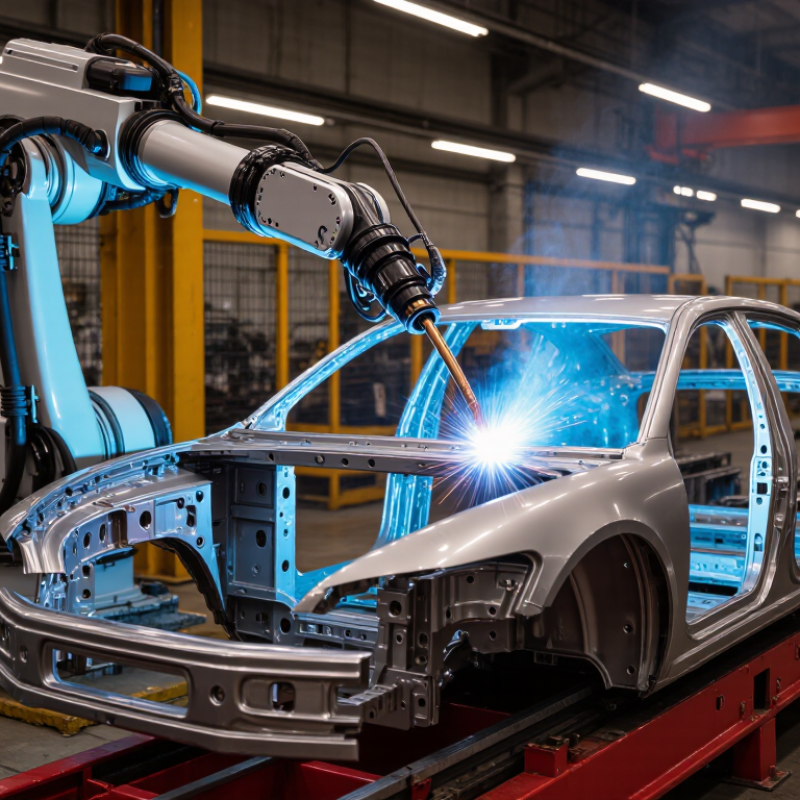
A welding robot arm is an articulated machine that carries a welding torch along a programmed path. Its joints move like a coordinated shoulder, elbow, and wrist, while a controller sets speed, position, and torch angle. The arm may be fixed in a workcell or mounted on a track for longer seams. It is not the welder itself; it provides repeatable motion around the welding process.
Before operation, technicians define the seam path and tune settings such as travel speed, wire feed, and arc voltage for the material and joint. During welding, sensors or carefully prepared fixtures help keep the torch aligned as the arm follows its programmed movements. The power source creates the arc, while shielding gas protects the molten metal from contamination. Small changes matter. A gap, warped plate, or dirty surface can affect the bead, even when the arm repeats its motion precisely. That distinction is easy to overlook. A robot can improve consistency and reduce awkward manual positioning, but it cannot fix poor joint preparation. Safe workcells also need guarding, fume extraction, and controlled access, with trained staff checking setup and weld quality.
| Section | Topic | Description | Typical Examples or Notes |
|---|---|---|---|
| Overview | What a welding robot arm is | A welding robot arm is a programmable industrial manipulator that moves a welding torch or, in some setups, a workpiece along a planned path. It is commonly integrated with a power source, wire feeder, sensors, safety equipment, and a robot controller. | Most arc-welding systems use a multi-jointed arm to position the torch at different angles and locations. |
| Overview | How it works | An operator or programmer defines the weld path, process settings, and sequence. The controller coordinates the arm and welding equipment; the torch travels along the joint while the selected process creates a weld. Sensors or fixtures may help locate parts and maintain the intended path. | Consistent results depend on correct programming, part fit-up, torch setup, process parameters, and inspection. |
| Use 1 | Automotive body and chassis welding | Performs repetitive arc welds on vehicle structures and assemblies where components can be presented in repeatable positions. | Examples include chassis components, brackets, and structural subassemblies. |
| Use 2 | Resistance spot welding | Positions a spot-welding gun to make a sequence of localized welds joining overlapping metal sheets. | Used in suitable sheet-metal assemblies; electrode access and clamping conditions affect the process. |
| Use 3 | Metal furniture and frame fabrication | Welds repeated joints in frames and tubular structures, helping maintain a consistent torch path across batches. | Examples include chair frames, shelving, and equipment stands. |
| Use 4 | Construction equipment components | Welds accessible joints on fabricated parts used in heavy machinery and related equipment. | Applications can include brackets, frames, and non-critical subassemblies; part size and weld procedure determine suitability. |
| Use 5 | Pipe and tube assemblies | Follows programmed paths around or along pipe and tube joints when the workpiece and torch can be positioned for access. | Rotators or positioners may be used to present circumferential joints consistently. |
| Use 6 | Sheet-metal enclosures and cabinets | Welds repeatable seams and joints on metal housings, panels, and fabricated enclosures. | Part fixturing helps control gaps and alignment, which are important for weld quality. |
| Use 7 | Agricultural machinery | Handles repeated welds on fabricated components used in agricultural machines and implements. | Examples include frames, guards, and support structures. |
| Use 8 | Rail and transport fabrication | Welds suitable transport-related structural parts and assemblies using programmed paths and controlled fixtures. | Production processes must follow applicable design, welding, and inspection requirements. |
| Use 9 | Weld cladding and surfacing | Deposits weld material along planned paths to build up or protect selected surfaces when the process and application are appropriate. | Often requires careful control of travel speed, deposition, heat input, and overlap. |
| Use 10 | Small-batch and custom fabrication | Automates suitable repeated weld sequences in job shops, particularly when parts can be fixtured and programs can be reused or adjusted. | Setup and programming time should be considered when production volumes are low or part designs change frequently. |
| Selection note | When a robot is suitable | Robotic welding is most effective when the joint path is repeatable, parts are consistently presented, and the work cell provides appropriate access and safety controls. | Manual welding may remain more practical for highly variable parts, difficult access, or frequent one-off work. |
Parts arrive from cutting or forming, then workers or machines clean and position them. A fixture holds each joint steady before welding.
It repeats a programmed path with a steady torch angle and travel speed. Process settings and inspection records can also help teams trace defects.
A poor fixture can shift a joint by a few millimeters and spoil the weld. Fit matters.
Repeated steel parts, such as beams, bridge girders, and modular frames, suit controlled welding cells. Misaligned pieces still need inspection and correction.
They weld long seams on ship panels and heavy components such as wind-tower sections. Thin plates can distort from heat, so people must check the results.
They can join metal enclosures, sensor housings, and brackets. Tiny parts move easily. Secure fixtures help protect nearby heat-sensitive components.
Reusable programs and adaptable fixtures can reduce setup work. Each new joint still needs trial welds and inspection.
No. People program paths, check samples, and respond when material thickness or part fit changes. Not magic. A neat demonstration can still hide setup problems.
A welding robot arm is a programmable machine that moves a welding tool along a planned path to join metal parts with consistent positioning and speed. To understand what is a welding robot arm used for, it helps to look at how it fits into manufacturing: it can work alongside fixtures, sensors, and production-line controls to repeat welding tasks, support steady output, and help workers handle demanding or repetitive operations.
Its uses span automotive and transportation assembly, heavy equipment production, construction components, shipbuilding, and energy infrastructure. In these settings, robotic welding can join parts of different sizes and shapes, from repeated assemblies to large structural sections. It also serves electronics manufacturing, general metal fabrication, and custom production, where precise, repeatable welds may be needed for small components or specialized designs. The setup and level of automation vary with the material, part geometry, production volume, and quality requirements.

 Sandai Robot