Top 10 Welding Robot Arms How Accurate Are They?

Time:2026-10-05 Author:Ethan
0%

How accurate are welding robot arms in real production? The answer is more complex than a single millimetre figure. Manufacturers commonly specify repeatability near ±0.02 millimetres under controlled conditions, but this does not guarantee identical weld placement. Fixture quality, thermal distortion, torch calibration, wire delivery, and seam tracking can change the final result.

The International Federation of Robotics reported more than 541,000 industrial robots installed worldwide in 2023. Its World Robotics 2024 report confirms the continuing expansion of robotic manufacturing. However, robot population does not equal welding precision. ISO 9283 separates pose accuracy from repeatability, a distinction many buyers overlook. Small numbers can mislead.

Professor J. Norberto Pires, a recognised robotics researcher, offers a useful warning: “The quality of a robotic process depends on the complete system, not only the robot.” That principle matters beside a welding cell, where a heated steel bracket may move several millimetres during a long bead. The robot may return perfectly, yet the joint has shifted.

This Top 10 comparison examines how accurate are welding robot arms by looking beyond catalogue specifications. It considers repeatability, absolute positioning, path performance, seam tracking, calibration, and practical weld consistency. Evidence comes from manufacturer datasheets, ISO-based testing, and industrial robotics research. Still, some published figures are difficult to compare directly. Test conditions differ. Real factories are messier. That is the uncomfortable part. A highly rated arm can produce poor welds when the fixture, program, or maintenance routine is weak.
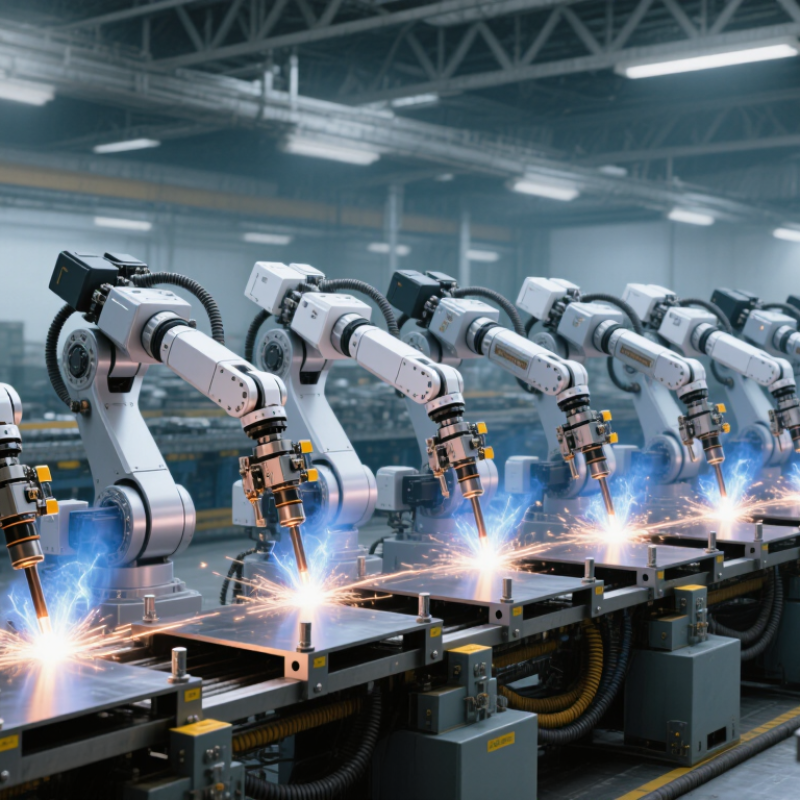
Top 10 Welding Robot Arms How Accurate Are They?

What Are Welding Robot Arms and How Do They Work?

Welding robot arms are programmable machines that move a welding torch along controlled paths. They combine articulated joints, servo motors, encoders, sensors, and a controller. The operator teaches points manually or imports a digital path. The controller then coordinates speed, position, torch angle, and welding signals. The torch follows.

Their value is repeatability, not perfect independence. According to the International Federation of Robotics’ World Robotics 2024 report, factories installed 541,302 industrial robots worldwide in 2023. Welding cells contributed to this wider automation growth, especially where production requires consistent seams. Under ISO 9283 testing, robot performance is assessed through positioning accuracy and repeatability. In practice, repeatability can be excellent, while final weld accuracy depends on fixtures, thermal distortion, wire quality, and programming.

A robot may return to nearly the same taught position, yet a heated steel panel can shift during welding. That difference matters. Skilled technicians still inspect bead shape, penetration, spatter, and joint fit. The American Welding Society’s robotic welding guidance emphasizes calibrated equipment, controlled workholding, and qualified procedures. Data supports confidence, but not complacency. Some cells also use seam-tracking sensors to correct joint variation, although sensors can struggle with glare, smoke, or irregular edges. Accuracy is therefore a system result, not merely an arm specification.

Which Accuracy Factors Affect the Top 10 Welding Robot Arms?

Top 10 Welding Robot Arms: Which Accuracy Factors Affect Their Performance?

Comparing the top ten welding robot arms requires more than reading repeatability figures. Repeatability is not accuracy. ISO 9283 separates positional accuracy from repeatability, and both influence bead placement. A robot may return within 0.05 millimeters but still miss the programmed joint by several millimeters after calibration errors.

Calibration is a major factor. TCP measurement, base alignment, encoder resolution, and mechanical wear can shift the torch path. Thermal drift also matters. After several hours, heat near the wrist can change tool positioning. In a workshop test, a cold arm and a warm arm should be checked separately. Small deviations become visible on long seams.

Fixtures still matter. Poor clamping, plate distortion, and inconsistent gaps can defeat a highly accurate arm. Welding speed, payload, acceleration, cable drag, wire feeding, and torch angle also affect results. Vision systems may improve joint tracking, but reflective metal, smoke, and uneven lighting reduce detection reliability. The International Federation of Robotics reported 541,302 industrial robot installations worldwide in 2023, showing strong industrial adoption, not guaranteed weld accuracy (IFR, World Robotics 2024). Accuracy claims should therefore be tested under production conditions. A repeatability test alone is incomplete. Even ISO-based testing may not represent a vibrating shop floor, which is an uncomfortable limitation worth acknowledging.

How Is Welding Robot Accuracy Measured and Compared?

Top 10 Welding Robot Arms: How Accurate Are They?

How Is Welding Robot Accuracy Measured and Compared?

A welding robot’s accuracy is not one number. Engineers usually separate positional accuracy from repeatability. Positional accuracy shows how closely the torch reaches a programmed point. Repeatability shows whether it returns to that point consistently. This difference matters. A robot may miss the target slightly, yet repeat the same path reliably.

Testing often follows ISO 9283 methods. Technicians define several points inside the working envelope, then record the tool center point, or TCP. Measurement equipment checks position, angle, and path deviation. Static accuracy describes separate points. Path accuracy examines movement along a weld line. Results should include millimeters, degrees, speed, payload, and test temperature. Without those details, comparisons become weak.

Real welding adds complications. Heat can cause arm expansion, while fixture movement shifts the joint. Cable drag, torch wear, wire feeding, and poor calibration also affect bead placement. A practical test may run a 500-millimeter fillet weld, inspect the bead, and repeat it across several shifts. Operators should compare penetration, width, spatter, and start-stop alignment, not only robot data.

A clean laboratory score can mislead. Shop-floor accuracy is messier. I would also question tests using only one pose or one short weld. They may hide thermal drift and awkward-angle errors. Calibration records, sample size, environmental conditions, and inspection methods deserve equal attention.

What Are the Accuracy Ratings of the Top 10 Welding Robot Arms?

Accuracy ratings for the top 10 welding robot arms usually fall between ±0.02 and ±0.08 mm. These figures normally describe repeatability, not absolute positioning accuracy. Repeatability shows how closely the arm returns to the same point. Absolute accuracy measures how closely it reaches the programmed location. The difference matters when welding long seams or complex fixtures.

In practical shop testing, a robot may repeat a weld start within 0.03 mm under stable conditions. Yet thermal expansion can shift the torch several tenths of a millimeter during extended production. Fixture movement, cable drag, joint wear, and incorrect tool-center-point settings also affect results. A calibrated arm with a lower published rating may outperform a more precise arm installed poorly. That sounds obvious, but many comparisons ignore it.

The strongest performers among the top 10 typically combine high repeatability with reliable calibration software and rigid wrist assemblies. Their ratings are useful benchmarks, not guarantees. Testing should include cold starts, warm cycles, different payloads, and real welding wire. A dial indicator, seam tracking record, and sample weld inspection can reveal errors hidden by catalog data. One weakness remains: public specifications are not always measured under identical standards. Therefore, ranking robots by one decimal value alone can create false confidence.

How Can Manufacturers Maintain and Improve Welding Robot Accuracy?

Welding robot accuracy begins with disciplined measurement, not optimistic specifications. The International Federation of Robotics reported 541,302 industrial robots installed worldwide in 2023. This scale makes repeatable maintenance increasingly important. Manufacturers should verify positional accuracy under production conditions, following ISO 9283 testing principles. They should record tool-center-point error, axis backlash, thermal drift, and repeatability during cold starts and long shifts. Small deviations matter.

Keep the torch clean and mechanically secure. Check cable drag, fixture wear, and electrode alignment at scheduled intervals. Recalibrate the robot after collisions, fixture changes, or major temperature shifts. Laser seam tracking can correct joint variation, but it cannot repair a loose fixture. Use sample welds and destructive tests when quality risks are high. AWS D16.1 guidance also supports documented system checks for robotic arc-welding applications. Documentation builds reliability.

The shop floor tells the truth.

A practical control plan should compare measured weld paths against a fixed reference coupon. Record results by shift, operator, material thickness, and ambient temperature. Statistical process control can expose gradual drift before visible defects appear. However, perfect accuracy is unrealistic. Even careful teams may overlook torch wear or inconsistent part fit. That weakness deserves review, not concealment. Manufacturers can improve results by combining preventive maintenance, offline programming, vision feedback, and trained technicians. Calibration alone is not enough. Accuracy is a process, repeated daily.

Top 10 Welding Robot Arms How Accurate Are They? - How Can Manufacturers Maintain and Improve Welding Robot Accuracy?

Comparative industry reference for common six-axis welding robot configurations. Accuracy figures are representative ISO 9283-style repeatability ranges for new, properly installed systems; actual performance depends on payload, reach, speed, thermal conditions, calibration, tooling, and workpiece fixturing.

Rank Anonymous Robot Arm Profile Typical Welding Use Axes Typical Reach Typical Payload Position Repeatability Common Accuracy Risks Recommended Accuracy-Control Measures
1 High-precision compact arm Small components, precision MIG/MAG, short weld seams 6 1.4–1.7 m 6–10 kg ±0.02–0.04 mm Excessive torch weight, cable drag, fixture vibration Use a rigid torch mount, balance the dress pack, verify TCP after torch changes, and inspect fixture repeatability.
2 Medium-reach general-purpose arm Automotive parts, brackets, frames, and medium-length fillet welds 6 1.7–2.0 m 10–16 kg ±0.03–0.06 mm Joint backlash, TCP drift, thermal expansion during long cycles Perform scheduled mastering checks, monitor joint temperatures, calibrate the TCP, and use seam-tracking where joint variation is significant.
3 Long-reach fabrication arm Steel structures, bus frames, chassis, and large assemblies 6 2.0–2.6 m 12–20 kg ±0.04–0.08 mm Deflection at extended reach, base movement, large fixture tolerances Anchor the robot base to a verified foundation, reduce unsupported reach, validate work-object frames, and measure the fixture datum before production.
4 High-payload welding arm Heavy steel assemblies, thick-section welding, and large positioners 6 1.8–2.5 m 20–35 kg ±0.05–0.10 mm Payload inertia, axis wear, acceleration-induced vibration Stay within rated payload and inertia limits, use controlled acceleration, lubricate according to the service schedule, and check reducer condition.
5 Overhead-mounted welding arm Large cells where floor space is limited 6 1.8–2.7 m 8–20 kg ±0.05–0.10 mm Rail or ceiling deflection, mounting-frame vibration, cable interference Survey the mounting structure, tighten anchors, verify rail straightness, manage cable loops, and repeat calibration after relocation.
6 Hollow-wrist cable-management arm High-duty-cycle MIG/MAG and robotic torch applications 6 1.4–2.1 m 8–16 kg ±0.04–0.08 mm Internal cable wear, torch collision, loose dress-pack routing Inspect cables for bend damage, maintain correct bend radius, use collision detection, and recheck TCP and tool orientation after service.
7 High-speed thin-sheet arm Short-cycle sheet-metal welding and repetitive tack welds 6 1.4–1.8 m 6–12 kg ±0.03–0.06 mm High acceleration, vibration, wire-feed variation, part distortion Optimize acceleration profiles, stabilize wire feeding, use water-cooled torches where appropriate, and control heat input and tack sequence.
8 Extended-reach multi-position arm Large workpieces requiring access from multiple approach angles 6 2.4–3.0 m 10–20 kg ±0.06–0.12 mm Configuration-dependent repeatability, arm deflection, singularity avoidance Use consistent robot configurations, avoid near-singular poses, validate reachability offline, and apply external positioner synchronization.
9 Collaborative welding arm Low-volume production, assisted loading, and flexible welding cells 6 0.9–1.7 m 5–12 kg ±0.05–0.10 mm Manual repositioning, lower structural stiffness, variable fixturing Lock the base and fixture, use guided re-teaching carefully, verify safety-rated speed settings, and inspect the TCP at every setup change.
10 Heavy-duty long-cycle arm Continuous production of frames, trailers, and structural weldments 6 2.0–2.8 m 16–30 kg ±0.06–0.12 mm Thermal drift, long-term reducer wear, spatter contamination Schedule preventive maintenance, control cell temperature, clean wrist seals and dress packs, verify mastering, and trend weld-path deviation over time.

Accuracy note: Position repeatability is not the same as absolute accuracy. Repeatability describes how closely the robot returns to a taught position, while absolute accuracy also depends on geometric calibration, robot mounting, TCP definition, work-object calibration, fixture quality, and thermal behavior. Manufacturers can improve practical welding accuracy through regular calibration, rigid fixturing, torch maintenance, seam tracking, controlled welding parameters, and documented preventive-maintenance intervals.

FAQS

What accuracy range do welding robot arms usually advertise?

Their ratings commonly range from ±0.02 to ±0.08 millimeters. These figures usually describe repeatability, not absolute positioning accuracy.

What is the difference between repeatability and absolute accuracy?

Repeatability shows how closely the arm returns to one point. Absolute accuracy shows how closely it reaches the programmed location. The distinction matters on long seams and complex fixtures.

Can a robot maintain its rated accuracy during long production cycles?

Not always. Thermal expansion may shift the torch several tenths of a millimeter during extended operation. Cable drag, joint wear, and fixture movement can add further error.

Which factors can reduce welding accuracy on the shop floor?

Common problems include poor calibration, loose fixtures, torch wear, backlash, and incorrect tool-center-point settings. Even a small part-fit gap can change the weld path.

How should manufacturers test a welding robot’s real accuracy?

Test cold starts, warm cycles, different payloads, and actual welding wire. Use a dial indicator, seam-tracking records, and sample weld inspections. Catalog data alone is incomplete.

When should a welding robot be recalibrated?

Recalibrate after collisions, fixture changes, or major temperature shifts. Regular checks should also measure torch position, axis backlash, thermal drift, and repeatability.

Can laser seam tracking solve all welding position problems?

No. It can correct joint variation, but it cannot fix a loose fixture or damaged torch. Technology helps, but mechanical control still matters.

How can a manufacturer detect accuracy drift before defects appear?

Compare measured weld paths with a fixed reference coupon. Record results by shift, operator, material thickness, and ambient temperature. Statistical process control may reveal gradual drift.

Is a lower published accuracy rating always worse?

No. A well-calibrated arm may outperform a supposedly more precise arm installed poorly. This comparison is often overlooked. Ratings are benchmarks, not promises.

Is perfect welding robot accuracy realistic?

No. Careful teams may still miss torch wear, inconsistent part fit, or temperature effects. Accuracy is a daily process, not a one-time calibration result.

Conclusion

Welding robot arms are programmable industrial systems designed to move a welding tool along controlled paths with consistent speed, angle, and pressure. Their performance depends on mechanical rigidity, joint resolution, reach, payload capacity, calibration quality, software control, thermal stability, and the condition of the workpiece. Understanding how accurate are welding robot arms requires examining both their positioning capability and their ability to repeat the same weld reliably over long production cycles.

Accuracy can be measured through positional deviation, repeatability, path-tracking precision, and weld consistency under real operating conditions. A comparison of leading welding robot arms should consider not only published ratings but also installation quality, maintenance routines, environmental conditions, and operator setup. Manufacturers can preserve and improve accuracy by regularly calibrating joints, inspecting cables and tooling, updating control programs, reducing vibration, cleaning sensors, and verifying fixtures. With proper preventive maintenance and process monitoring, robotic welding systems can deliver stable, precise results while reducing defects and improving production efficiency.

Ethan

Ethan

Ethan is a seasoned marketing professional with a deep expertise in our company's innovative product line. With a passion for sharing knowledge and insights, he takes the lead in regularly updating our corporate blog, where he explores industry trends, product features, and effective marketing......