How much does a welding robot arm cost? The honest answer is less tidy than many buying guides suggest. A bare six-axis arm may cost approximately $25,000 to $75,000, according to published supplier and integrator pricing. A complete welding cell can exceed $100,000 and reach $250,000 or more. The final figure depends on payload, reach, welding power source, positioners, safety guarding, programming, installation, and operator training.
Industry demand is growing. The International Federation of Robotics reported 541,302 industrial robots were installed worldwide in 2023, with more than 4.28 million operating globally. The report does not isolate welding systems, but it shows why manufacturers are examining automation more seriously. A welding cell is not merely a mechanical arm. Picture the full workstation: a torch cable, wire feeder, rotary positioner, fume extraction, sensors, fencing, and a technician adjusting parameters beside the fixture.
Jim Lawton, a former Universal Robots executive and robotics-industry specialist, has often emphasized a practical principle: “Automation is not about replacing people; it’s about augmenting people.” That idea matters when calculating return on investment. Labor savings alone may not justify the purchase. Reduced rework, steadier weld quality, fewer production interruptions, and improved worker safety can change the calculation.
Still, estimates can be imperfect. Used equipment may appear inexpensive, yet obsolete controllers and unavailable parts can quietly increase costs. This guide examines seven buying tips, compares realistic ownership expenses, and explains what buyers should verify before signing a quotation. A low initial price is not always a low-cost solution.
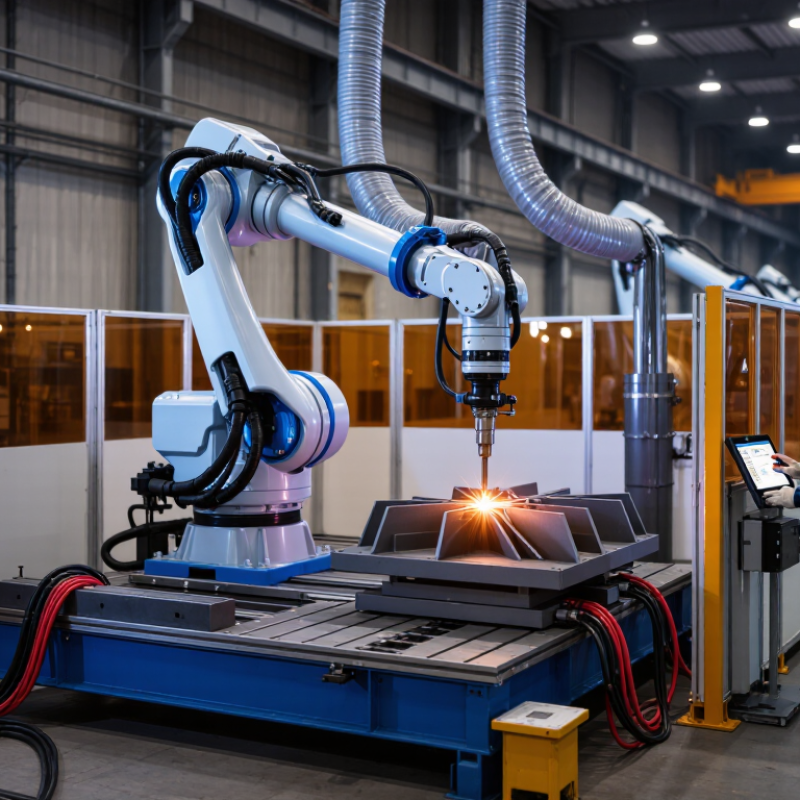
A welding robot arm is a programmable machine that moves a welding torch along a planned joint. Most systems include a six-axis arm, power source, wire feeder, controller, torch, and safety enclosure. The controller stores welding paths, speeds, angles, and voltage settings. The arm repeats these movements with consistent timing.
Not magic. A technician first teaches the torch’s position, travel speed, and contact distance. During operation, sensors may detect joint location, arc conditions, or torch deviation. A positioner can rotate the workpiece while the arm welds. This coordination reduces awkward manual movements and supports stable bead placement. However, poor fixtures can still create gaps, spatter, and weak joints. In real workshops, setup quality often matters as much as the arm.
The International Federation of Robotics reported 541,302 industrial robots were installed worldwide in 2023. Its World Robotics 2024 report also recorded about 4.28 million robots operating globally. These figures show wider adoption, but they do not guarantee savings for every welding cell. The arm is only one cost. A buyer should price the torch, positioner, programming, guarding, training, maintenance, and integration. Ask for a measured cycle-time trial using your actual parts. I would not trust a payback estimate built only on brochure assumptions. A realistic test should include changeovers, rejects, downtime, and operator learning time.
The arm alone may cost about $25,000–$80,000. A complete welding cell can exceed $150,000. The final price depends on reach, payload, speed, axes, and repeatability. Not a simple purchase.
A welding system may include a power source, torch, wire feeder, cooling unit, and sensors. Seam-tracking software can add several thousand dollars. Positioners, safety fencing, light curtains, extraction, installation, and training also increase costs. Small extras accumulate.
A six-axis arm with a 10-kilogram payload may suit medium steel frames. Heavy fixtures need stronger joints and possibly greater reach. Higher payload capacity usually raises the equipment price. Choose for real loads.
Six-axis articulated arms suit corners, pipes, and uneven frames. Their wrists rotate through tight angles. They offer flexibility and may reduce fixture changes. The trade-off is higher cost and more programming complexity.
Cartesian robots move along straight X, Y, and Z rails. They suit long welds and repeatable production lines. Gantry systems cover very large work areas and handle heavy assemblies. Not always compact.
Collaborative arms can work near people under controlled operating conditions. They suit smaller spaces and frequent product changes. Their speed and payload may not match heavy industrial arms. Test the actual workload.
Ask about fixture design, control integration, guarding, programming, and cable routing. A positioner may improve torch access but require extra controls. A cheaper arm can create expensive installation work. That matters.
Check calibration costs, service availability, consumable use, and annual maintenance rates. Request weld samples, fixture drawings, and cycle-time trials. Programming must be practical for operators. My first estimate could be too optimistic.
Test the intended weld path with real materials and actual fixtures. Check torch access, cable movement, welding speed, and repeatability. A showroom weld may look perfect. Reality can disagree.
Choosing the right welding robot arm begins with understanding how it works. These automated systems use programmable joints, welding tools, sensors, and control software to perform consistent welds with minimal manual intervention. If you are asking, “how much does a welding robot arm cost,” the answer depends on factors such as payload capacity, reach, welding process, positioning equipment, safety systems, software, installation, and training. Basic systems may cost less, while advanced solutions designed for complex production require a larger investment.
Common options include articulated robot arms, collaborative welding robots, and integrated robotic welding cells. To compare them effectively, look beyond the purchase price and evaluate speed, accuracy, duty cycle, ease of programming, maintenance needs, energy use, and expected service life. Important buying tips include defining your production volume, checking workspace compatibility, confirming support and spare-part availability, calculating total ownership costs, and choosing a system that can expand with future requirements. A careful comparison helps balance automation performance, operating expenses, and long-term return on investment.

 Sandai Robot