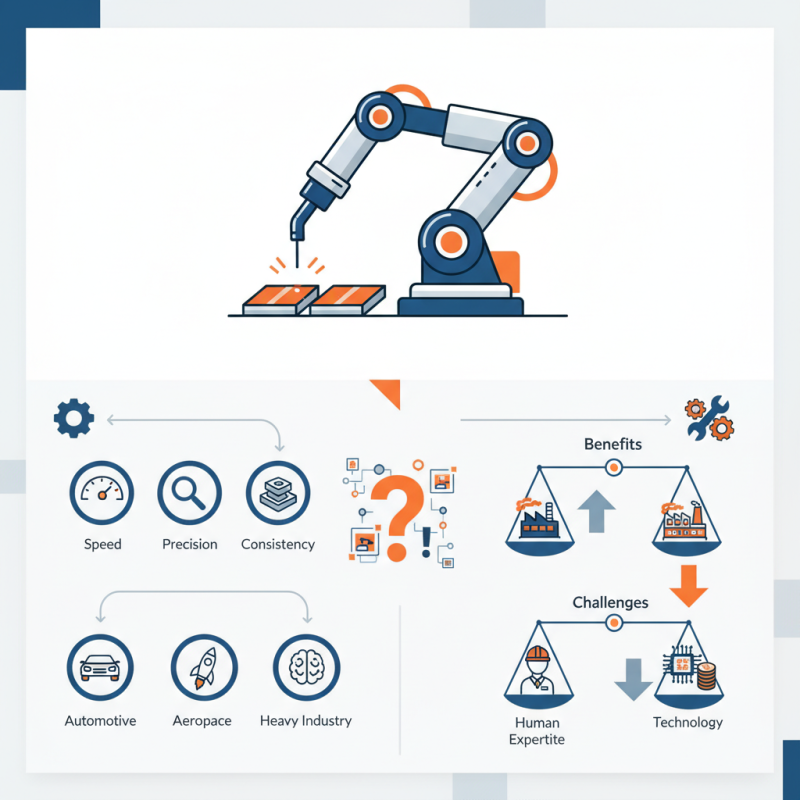
In today’s competitive manufacturing landscape, efficiency is paramount. A welding robot arm plays a significant role in achieving this goal. But what is a welding robot arm used for? It is designed to automate welding processes, greatly enhancing precision and speed. By utilizing advanced technology, it reduces human error and ensures consistent results.
Welding robot arms can handle various materials and complex shapes. They streamline operations in automotive, aerospace, and heavy industries. This reliability makes them essential for high-volume production. However, integrating such technology does come with challenges. Operators must develop skills to work alongside robots.
While the benefits are clear, companies must also consider potential drawbacks. High initial costs and the need for maintenance can deter some businesses. Understanding these factors is crucial for effective decision-making. Balancing technology and human expertise will lead to better outcomes in modern manufacturing.
Role of Welding Robot Arms in Increasing Manufacturing Efficiency
Welding robot arms are transforming modern manufacturing. They boost efficiency significantly in production lines. A recent industry report shows that automation can increase productivity by up to 30%. This leap allows manufacturers to meet growing demand while reducing labor costs.
Moreover, welding robot arms ensure consistent quality. They minimize human error and variation in welds. According to the International Federation of Robotics, companies using welding robots reported a 50% reduction in defects. However, reliance on technology can raise concerns. If systems fail, it can halt production. Training staff to manage these machines is crucial.
Additionally, welding robots offer flexibility. They can be reprogrammed for different tasks. This adaptability is essential in a rapidly changing market. Despite their benefits, initial setup costs can be high. Many businesses struggle with the ROI in the short term. Balancing automation and skilled labor is an ongoing challenge.
Analysis of Cost Savings Achieved Through Automated Welding Solutions
In modern manufacturing, automated welding solutions have become essential for achieving significant cost savings. By employing welding robot arms, companies can enhance productivity while reducing labor costs. These robots operate with high precision and minimal errors, which helps to decrease material wastage. This precision is crucial in industries where even slight defects can lead to costly rework.
To maximize savings, businesses should consider the initial investment. The capital outlay for robotic systems can be considerable, but it's important to assess long-term benefits. Over time, many firms notice a reduction in overtime expenses and an increase in throughput. Evaluating the payback period is key to understanding the true cost-effectiveness of these systems.
Tip: Regular maintenance of robotic arms ensures longevity and consistent performance. A well-maintained robot minimizes downtime and maintains output levels.
Implementing automation isn't without challenges. Some may face a steep learning curve when integrating new technologies. Training staff to work alongside robots is crucial but can require additional time and resources. It's vital to foster a collaborative environment where human and machine capabilities complement each other.
Tip: Start with smaller projects to build confidence and experience. Gradually expanding automation can lead to greater overall efficiency.
Impact of Welding Robot Arms on Quality and Precision in Production
Welding robot arms are transforming modern manufacturing by enhancing quality and precision in production. A recent study by the International Federation of Robotics revealed that companies using robotic welding experience a 50% reduction in defects. This data highlights the undeniable relationship between automation and improved manufacturing outcomes.
Welding robots can maintain consistent heat and speed, leading to uniform welds that human operators may struggle to achieve due to fatigue and variability.
However, the integration of welding robots is not without its challenges. Proper programming and training are essential for optimal operation. According to a report from the American Welding Society, about 30% of welding operations still rely on manual techniques. This suggests a gap in education and training in automation technologies. Companies must invest in workforce development to bridge this gap and realize the full benefits of robotic welding.
Tip: When considering a shift to robotic welding, evaluate existing processes and staff capabilities. Investing in training can drastically improve the effectiveness of automated systems.
Tip: Regular maintenance of welding robots is crucial. Neglect can lead to costly downtimes and affect overall production quality.
Trends in Robotics: Increasing Adoption of Welding Robots in Various Industries
In recent years, the manufacturing landscape has shifted significantly. One standout trend is the increased adoption of welding robot arms across various industries. These advanced machines enhance precision and productivity, offering a level of consistency that is hard to achieve manually. As industries strive for efficiency, welding robots are becoming indispensable.
The rise of automation in welding processes has been noteworthy. Manufacturers are recognizing the value of robotics for streamlined operations. Welding robots can work continuously without fatigue, leading to reduced downtime. They adapt to different tasks and materials, making them versatile solutions. Industries like automotive and aerospace are leveraging this technology for better performance and safety.
However, reliance on welding robots raises questions. Are human skills being undervalued? While robots enhance efficiency, they cannot replicate the intuition of experienced welders. Training and upskilling workers remain essential as automation takes hold. Balancing technology and human expertise will be crucial for future manufacturing success.
Why is a Welding Robot Arm Essential for Modern Manufacturing?
| Industry |
Percentage of Adoption (%) |
Advantages of Welding Robots |
Common Applications |
| Automotive |
85 |
Increased precision, reduced labor costs |
Chassis assembly, bodywork |
| Aerospace |
75 |
High repeatability, safety standards |
Aircraft components, structural assemblies |
| Shipbuilding |
70 |
Improved weld quality, reduced cycle time |
Hull assembly, pipe fittings |
| Construction |
60 |
Consistency, reduced waste |
Structural beams, reinforcement |
| Energy |
65 |
Enhanced productivity, minimized downtime |
Pipeline construction, turbine assembly |
Future Prospects: Innovations and Developments in Welding Robotics Technology
The future of welding robotics technology is bright and evolving rapidly. Innovations in artificial intelligence and machine learning are enhancing robot arms' capabilities. These advancements allow for more precise welding, reducing human error and increasing safety.
Tip: Regular maintenance of welding robots can significantly improve their efficiency and lifespan. Ensuring that components are regularly checked will minimize downtime.
Enhanced sensors and adaptive learning systems enable robots to adjust processes on the fly. This flexibility is crucial for intricate designs and high-strength materials. As industries demand better performance, these technologies will need constant refinement.
Tip: Training your workforce on the latest welding robotics can boost productivity. Knowledgeable employees can make better use of the technology.
Considering the prospects ahead, we see the integration of collaborative robots. These robots work alongside humans, sharing workflows and improving production speed. They can also file adaptive learning data for continuous improvement. As these developments unfold, the welding industry will likely transform significantly, offering new opportunities and challenges.
FAQS
: They enhance productivity by up to 30%, allowing companies to meet demand while lowering labor costs.
They reduce human error and variation, leading to a 50% decrease in defects reported by companies using them.
Yes, system failures can halt production. Training staff to manage equipment is essential to minimize risks.
Yes, they can be reprogrammed, making them versatile for different materials and processes in a dynamic market.
High initial setup costs can complicate ROI calculations. Balancing automation with skilled labor is an ongoing struggle.
While robots enhance efficiency, they may undervalue human intuition. Ongoing training of workers is still vital.
Advancements in AI and machine learning will lead to more precise welding and enhanced safety measures.
Regular maintenance is crucial. It improves efficiency and extends the lifespan of the equipment.
These robots work alongside humans, sharing tasks. They enhance production speed and support continuous improvement.
Educated employees can leverage technology better, enhancing overall productivity and ensuring effective operation of robots.
Conclusion
Welding robot arms have become an integral part of modern manufacturing, significantly enhancing efficiency and productivity. They are primarily used for automating the welding process, which not only accelerates production rates but also minimizes human error. By implementing these robotic solutions, manufacturers can achieve notable cost savings, as the need for manual labor is reduced and operational costs are cut.
Moreover, the precision and consistency offered by welding robot arms greatly improve the quality of the final products. As industries increasingly adopt robotics technology, the trend signifies a shift towards more automated solutions, with continued innovations promising even greater advancements in welding capabilities. In summary, a welding robot arm is used for streamlining operations, ensuring high-quality welds, and driving future developments in the manufacturing sector.

 Sandai Robot