The evolution of welding technology raises the question: can welding robot arms replace manual welding? Experts like Dr. Steven Harper, a leading authority in robotics, argue that while automation offers speed and precision, it cannot fully replicate the human touch. He states, "Robots excel in repetitive tasks but lack the adaptability of skilled welders."
In many industries, welding remains a craft driven by human skill. Manual welders can assess materials and adjust techniques on the fly. This flexibility is crucial in complex projects. Robot arms, while efficient in structured environments, struggle with unpredictable conditions.
As we look toward 2026, the debate continues. Cost savings and efficiency drive companies to adopt robotic welding. However, relying solely on machines can lead to quality control issues. A balanced approach, blending both human expertise and robotic precision, may be the ultimate solution. The challenge lies in finding that equilibrium.
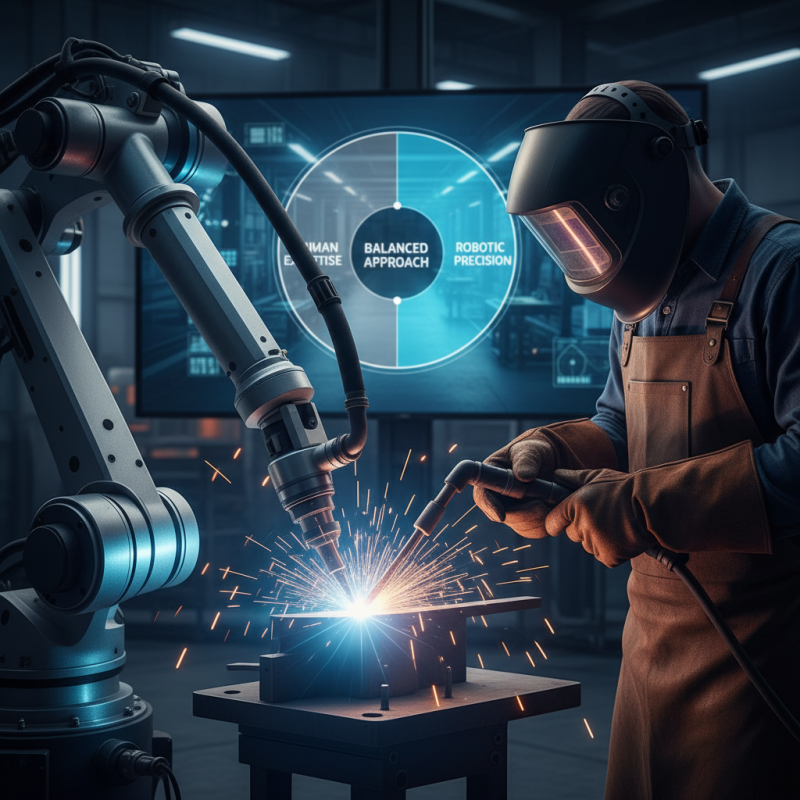
The Evolution of Welding Technology: Manual vs. Robotic Welding
The welding industry has seen significant advancements, shifting from manual techniques to robotics. In 2023, reports indicated that robotic welding accounted for around 30% of overall welding processes. This growth highlights a trend toward automation, promising efficiency and precision. However, manual welding still holds a vital place in certain applications, especially where intricate craftsmanship is required.
One critical aspect of this evolution lies in the adaptability of welding technologies. Robots excel in repetitive tasks, enhancing productivity by up to 25%. Yet, they struggle with complex welds that demand a human touch. A study from the American Welding Society noted that manual welders often produce superior results in unique situations. This indicates that while robots can enhance efficiency, they can't entirely replace the skilled judgment of experienced welders.
Tips to consider: Always assess the specific needs of your projects before choosing automation. A hybrid approach may offer the best of both worlds. Training programs for welders can enhance their skills for collaboration with robotic systems, fostering a blended workforce. Embracing both technologies will likely yield the most versatile and effective results in the industry.
Can Welding Robot Arms Truly Replace Manual Welding in 2026?
| Aspect |
Manual Welding |
Robotic Welding |
| Initial Cost |
Lower |
Higher |
| Operational Cost |
Higher |
Lower |
| Flexibility |
Very Flexible |
Limited Flexibility |
| Speed |
Moderate |
Fast |
| Quality Consistency |
Variable |
High Consistency |
| Skill Requirement |
High |
Moderate |
| Job Safety |
Moderate |
High |
| Scalability |
Limited |
Easily Scalable |
Current Market Trends: Growth of Welding Robots by 2026
The welding robot market is experiencing notable growth. By 2026, more companies are expected to adopt automated solutions. Welding robots offer enhanced precision and efficiency. They can work tirelessly, providing consistent results. This marks a significant shift from traditional manual welding practices.
Current trends indicate a surge in demand for welding robots. Industries are recognizing the benefits of automation, especially in heavy-duty manufacturing. Labor shortages are prompting businesses to seek reliable solutions. Yet, the high initial investment remains a hurdle for smaller companies. There is a risk that reliance on robotics may lead to a loss of skilled labor. Striking a balance will be crucial for future growth.
As companies navigate this transition, challenges arise. Technical expertise is necessary for maintenance and operation. Training programs will be essential but may lag behind the technology. Manufacturers must ensure that workers can adapt to new methods. Only then can the industry truly thrive in an automated world.
Advantages of Robotic Welding: Efficiency, Precision, and Cost Savings
Robotic welding presents significant advantages over traditional manual techniques. One major benefit is efficiency. Robots can operate continuously, with minimal downtime. They can complete repetitive tasks quickly, leading to higher production rates. This efficiency translates directly into better output and faster turnaround times. Factories utilizing robotic arms often see a notable increase in their workflow.
Precision is another crucial factor. Welding robots can execute tasks with an accuracy that often surpasses human capabilities. The advanced sensors and programming allow robots to maintain consistency. This reduces the chances of defects and rework. For industries where quality is vital, robotic welding is becoming a standard.
Cost savings also play a big role in this shift. Although the initial investment in welding robots can be high, the long-term savings are substantial. Lower labor costs, fewer material waste issues, and less downtime all contribute to financial benefits. However, it’s essential to consider training for staff to operate and maintain these machines. Integrating robotic systems requires a thoughtful approach to workforce management. Adapting to this change may not be seamless for every company.
Can Welding Robot Arms Truly Replace Manual Welding in 2026?
Challenges in Replacing Manual Welding: Skill Gaps and Adaptation
The evolution of welding technology prompts a critical conversation about the future of manual welding. While robotic arms offer precision, the shift isn't without challenges. A significant hurdle is the skill gap. According to a report from the American Welding Society, around 50% of the welding workforce is nearing retirement. This raises concerns about finding qualified professionals to operate advanced robotic systems.
Moreover, worker adaptation plays a vital role in this transition. A survey published in the Journal of Manufacturing Science and Engineering revealed that 65% of industrial workers feel unprepared for automation. Bridging this skill gap is essential for a smooth integration of robotic technologies. Welding education programs must evolve to incorporate both manual and robotic skills.
Tip: Invest in training programs that emphasize both traditional welding techniques and robotics. Encourage hands-on experience to build confidence.
It's essential to recognize that not all tasks can be automated. Complex geometries and intricate designs often require the
finesse of experienced welders. As robots become more prevalent, manual skills remain invaluable.
Tip: Foster a culture of continuous learning within the workforce to prepare for emerging technologies. Regular workshops can help in keeping skills relevant.
Forecasting the Future: Industry Experts' Predictions on Welding Automation
The landscape of welding is evolving rapidly. Experts predict that by 2026,
welding robots could potentially take over many manual welding tasks.
However, whether they can fully replace human welders remains a topic of debate. Many industry specialists
highlight the importance of adaptability in welding operations. Robots may excel in repetitive tasks but
struggle with complex maneuvers. The need for human oversight persists.
Automation brings benefits like
increased precision and
efficiency. Yet, it introduces challenges.
Workers might need retraining to work alongside robots.
There are concerns about job displacement. While automation can enhance productivity, it also requires a skilled
workforce to manage and maintain these systems. This juxtaposition highlights the ongoing need for reflection on
the human role in welding.
Looking forward, the welding industry must balance the advantages of automation with the invaluable insights provided
by experienced welders. Experts advise blending technology with human skill. As innovations emerge,
the industry must continually adapt. The road ahead may not be straightforward. The ultimate success of welding automation
relies on collaboration between robots and skilled workers.
FAQS
: The shift is due to advancements in automation that enhance efficiency and precision.
Robotic welding accounts for around 30% of overall welding processes.
No, robots excel in repetitive tasks but struggle with complex welds needing human craftsmanship.
Manual welding is crucial for intricate projects that require skilled judgment and unique results.
A significant challenge is the skill gap, as many welders are nearing retirement.
About 65% of industrial workers feel unprepared for the shift to automation.
Education programs must teach both traditional and robotic welding skills to bridge the skill gap.
Invest in training programs that provide hands-on experience in both welding techniques.
No, intricate designs often require the finesse of experienced manual welders.
Regular workshops and training can help keep skills relevant as technology evolves.
Conclusion
The article explores the question of whether welding robot arms can replace manual welding by 2026. It begins by examining the evolution of welding technology, contrasting traditional manual welding with modern robotic techniques. Current market trends indicate a significant growth in the adoption of welding robots, highlighting their advantages in efficiency, precision, and cost savings compared to manual methods. However, the transition faces challenges, such as skill gaps in the workforce and the need for adaptation to new technologies.
Industry experts predict that while robotic welding will play an increasingly prominent role, a complete replacement of manual welding is unlikely due to the complexities of certain tasks that require human insight and finesse. In conclusion, while welding robot arms can enhance productivity, a hybrid approach that integrates both robotic and manual welding may be the most effective solution moving forward.

 Sandai Robot